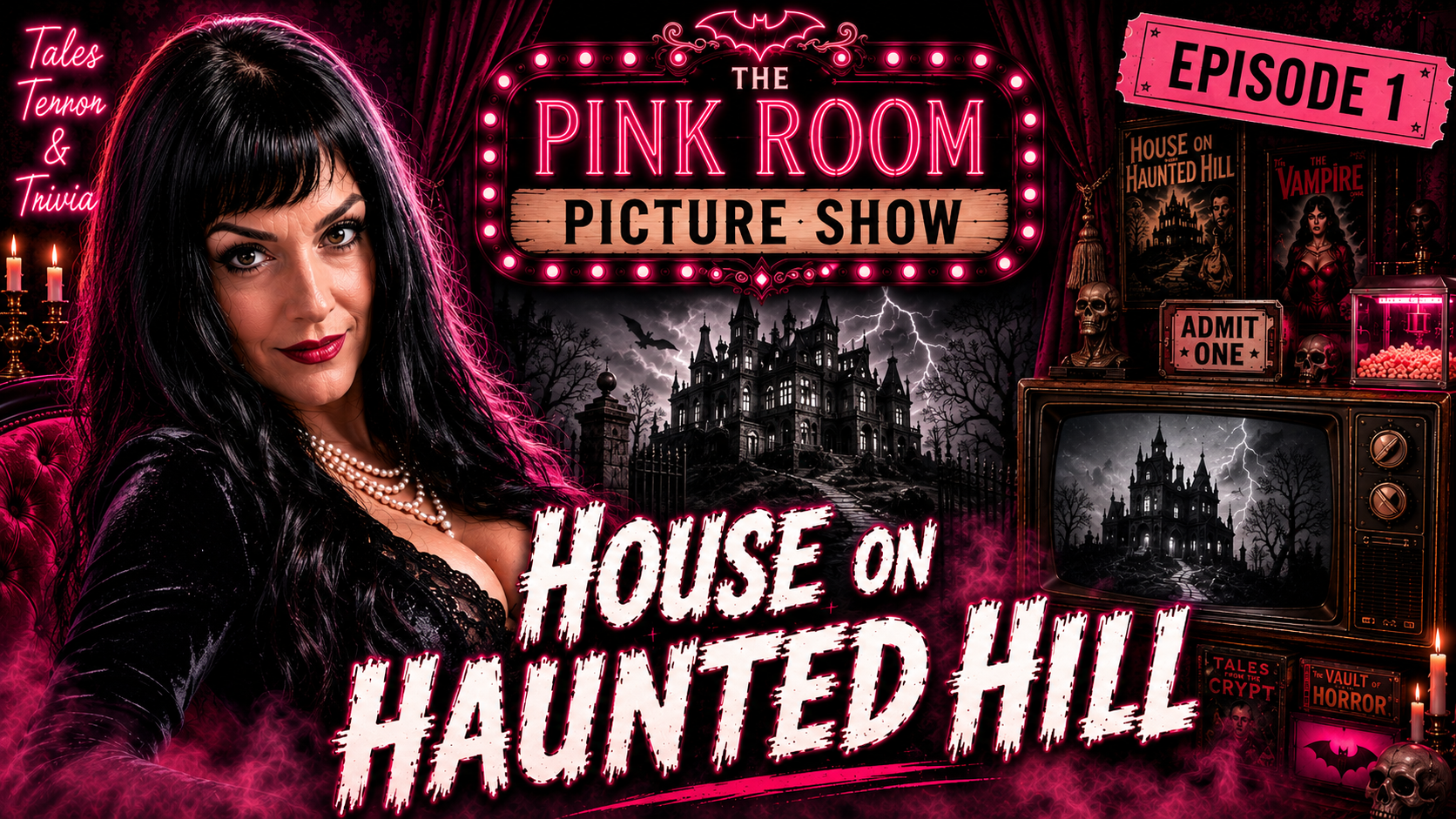

The Pink Room Picture Show
Five strangers. One locked house. Ten thousand dollars.
Vincent Price invites you to the most dangerous cocktail party in horror history, where the doors lock at midnight and surviving until morning may be worth more than money.
Hello, my darlings—and welcome to the house where the Pink Room Picture Show began. Before the portal, before the expanding universe and before Walter started appearing in windows, there was Vincent Price standing in the darkness with an invitation no sensible person should accept.
House on Haunted Hill is pure William Castle showmanship: elegant, sinister, playful and always aware that a horror movie should feel like an event. It brought together Castle’s carnival-barker imagination and Vincent Price’s velvet-smooth menace, then locked them inside a mansion with five desperate strangers, a collection of loaded pistols, an acid vat and one deeply unhappy marriage.
It was the perfect film to open the doors of the Pink Room Picture Show—and it became the episode that first showed how many viewers were waiting to come inside.
Watch the complete movie with Veronica in the Pink Room
- Title
- House on Haunted Hill
- Release
- 1959
- Produced & directed by
- William Castle
- Written by
- Robb White
- Starring
- Vincent Price, Carol Ohmart, Richard Long, Carolyn Craig and Elisha Cook Jr.
- Runtime
- 75 minutes
An Invitation from Frederick Loren
Eccentric millionaire Frederick Loren, played with exquisite composure by Vincent Price, rents a house with a murderous reputation. He and his wife Annabelle invite five strangers to spend the night. Anyone who remains inside until morning will receive ten thousand dollars.
The guests arrive in funeral cars. The doors lock at midnight. Each person receives a small coffin containing a loaded pistol. Before long, chandeliers fall, blood drips from ceilings, severed heads appear where no severed heads should be, and Nora Manning becomes convinced that something inside the house wants her dead.
The delicious question is never simply whether the house is haunted. It is whether Frederick and Annabelle are more dangerous than any ghost could ever hope to be.
Vincent Price does not merely enter a room. He makes the room understand that it now belongs to him.
Vincent Price at His Most Delicious
Frederick Loren is one of the roles that helped solidify Vincent Price as a horror icon. He is charming, amused and impossible to read. Every line shared with Annabelle carries the polish of a champagne glass and the edge of a razor.
Price never needs to shout to command the picture. A lifted eyebrow can imply an entire conspiracy. A polite smile can feel more threatening than a scream. He allows the audience to enjoy Frederick’s sophistication while never letting us forget that this is a man who may have planned something dreadful.
Opposite him, Carol Ohmart gives Annabelle exactly the right poisonous glamour. Their marriage is the film’s most convincing haunting: beautiful on the outside, dead and dangerous within.
William Castle Makes Horror an Event
William Castle understood that audiences did not merely buy tickets to see a movie. They bought the story surrounding the movie—the dare, the anticipation and the feeling that something might escape the screen.
For selected first-run screenings of House on Haunted Hill, Castle created a theatrical gimmick he called Emergo. At the appropriate moment, a full-sized plastic skeleton traveled along wires above the audience. The film’s own closing credits even include the immortal line: “Skeleton by Himself.”
It was playful, shameless and brilliant. Castle turned the entire theater into part of the attraction. Long before immersive cinema became a fashionable phrase, he understood that a memorable presentation could make a modestly budgeted movie feel enormous.
The House That Is Never Quite the Same House
The unforgettable exterior is Frank Lloyd Wright’s Ennis House in Los Feliz, California. Its geometric architecture gives the mansion an ancient, almost alien severity. Inside, however, the movie shifts into a very different world of creaking doors, gloomy corridors, gaslight and Gothic clutter.
The mismatch should be distracting, yet it adds to the dreamlike unease. The house refuses to settle into one identity. It is modern from the outside, Victorian within, and something far stranger underneath.
Elisha Cook Jr.’s Watson Pritchard gives the building its mythology. He speaks of the house as though it is not merely haunted but hungry. While the other guests debate tricks, motives and murder, Pritchard remains certain: the ghosts are real, and they are coming for all of them.
Why It Opened the Pink Room
House on Haunted Hill contains everything the Pink Room Picture Show was created to celebrate: a magnetic host-like presence, macabre humor, old-Hollywood glamour, practical theatricality and a story that welcomes the audience as a guest before quietly locking the door behind them.
Beginning the series with William Castle also felt right. Castle believed presentation mattered. He knew viewers wanted more than a file playing on a screen; they wanted an evening, an invitation and a shared experience. That same belief lives at the center of the Pink Room.
This first episode did more than introduce a classic film. It opened a door. The audience stepped through, the Pink Room began to grow, and the lights have been glowing ever since.
Sources & Further Reading
- AFI Catalog: House on Haunted Hill — cast, production credits, runtime and the history of Emergo.
- Academy of Motion Picture Arts and Sciences — Vincent Price, Ennis House and William Castle’s theatrical gimmick.
- Wikimedia Commons film record — preserved film copy and U.S. public-domain status.
- Wikimedia Commons theatrical poster record — Reynold Brown poster artwork and rights information.
The doors are locked, my darling. You may as well stay for another picture.
VeronicaTot Comics · Because Comics Deserve Couture Too