
Category: Science Fiction

  • Phantom from Space: Invisible Terror, Radio Static and a Visitor from the Stars

    Phantom from Space: Invisible Terror, Radio Static and a Visitor from the Stars

    Noreen Nash as Barbara Randall in Phantom from Space
    Noreen Nash as Barbara Randall in Phantom from Space · 1953 film still · Public domain in the United States

    The Pink Room Picture Show

    Something landed. Then it vanished.

    A visitor tears across radar screens from Alaska to California, crashes near Santa Monica and leaves authorities hunting something they cannot see, cannot understand and may not be able to keep alive.

    1953Science Fiction
    70–72 MinutesBlack & White
    Invisible Alien

    Hello, my darlings. Before flying saucers became polished silver icons and movie aliens arrived with elaborate empires behind them, Phantom from Space imagined first contact as something much stranger: a frightened visitor, a radioactive suit, a trail of static—and an invisible body moving through the California night.

    Released in 1953 and directed by W. Lee Wilder, this compact little science-fiction thriller sits right at the crossroads of postwar UFO fever, atomic-age anxiety and the semi-documentary crime pictures that loved official voices, radar rooms and men in government offices explaining that something impossible had just happened.

    It does not begin with a monster. It begins with a signal.

    Watch the complete movie with Veronica in the Pink Room

    Title
    Phantom from Space
    Release
    May 15, 1953
    Directed by
    W. Lee Wilder
    Written by
    Bill Raynor and Myles Wilder
    Starring
    Ted Cooper, Rudolph Anders, James Seay, Noreen Nash and Dick Sands
    Music by
    William Lava
    Production
    Planet Filmplays, Inc.
    Runtime
    Approximately 70–72 minutes

    A Visitor Falls Out of the Sky

    The movie opens with authority. Radar stations track an unidentified object screaming south from Alaska at impossible speed. It loses altitude, crosses the country and disappears from radar near Santa Monica. Almost immediately, radio and television interference begins to spread through the area.

    Mobile communications crews are dispatched to locate the source. What they find is not wreckage neatly waiting to be photographed. They find frightened witnesses, injured men and reports of a strange figure wearing what looks like a heavy diving suit and helmet.

    The government men follow the disturbances toward the San Fernando Valley and an observatory laboratory, where scientists begin to suspect that the suit is not merely protective clothing. It is keeping its wearer alive.

    The most unsettling thing in Phantom from Space is not that the visitor can disappear. It is that nobody knows whether he is hunting us—or simply trying to survive us.

    The Monster We Cannot See

    The central gimmick is beautifully simple. Once the alien removes his suit, he becomes invisible to human eyes. Doors open by themselves. Equipment moves. Footsteps and alarms announce a presence the characters cannot locate. The movie turns a modest budget into an advantage because absence becomes the special effect.

    There is a practical reason for the invisibility inside the story as well. Dr. Wyatt theorizes that the visitor’s body may be based on chemistry unlike our own, and ultraviolet light can reveal traces of him. His strange helmet contains the gas he needs to breathe. Without it, every minute on Earth becomes more dangerous.

    That detail changes the mood. The Phantom is dangerous, certainly, and people are hurt in the panic surrounding his arrival. But the film gradually presents him less as a conquering invader than as a stranded being trapped in an environment that is killing him while terrified humans close in.

    Government Men, Static and Atomic-Age Fear

    Wilder directs much of the picture like a procedural. The American Film Institute notes the film’s documentary-style narration, and that tone gives the opening sections an almost official seriousness. Communications trucks, military personnel, laboratory workers and radar operators treat the impossible as another problem to be logged, triangulated and contained.

    That is pure early-1950s science fiction. The unknown arrives through technology before it arrives through character. We see it first as a radar trace, a disturbance in radio signals and a problem moving through networks designed to keep the modern world connected.

    The picture also belongs to the same cultural moment that produced endless headlines and movies about flying saucers, radiation and visitors from beyond Earth. Instead of building enormous effects sequences, Phantom from Space keeps those anxieties close to the ground. Its alien hides in laboratories, crosses roads at night and turns familiar Southern California locations into a place where ordinary rules no longer quite apply.

    Noreen Nash and the Human Face of the Story

    Noreen Nash plays Barbara Randall, one of the laboratory figures drawn directly into the encounter. She becomes especially important once the scientists realize the alien may be trying to communicate by tapping out a repeated pattern.

    That possibility—communication instead of simple destruction—is where the movie becomes more interesting than its pulpy title suggests. The Phantom is silent, visually absent and physically incompatible with our atmosphere. Human beings can barely perceive him, much less understand him. Yet there are moments when both sides seem to be reaching toward the same goal: make contact before fear or biology makes contact impossible.

    Dick Sands performs the Phantom when the creature is finally revealed, while Rudolph Anders plays Dr. Wyatt and James Seay appears as Major Andrews. The supporting cast gives the picture the sturdy, no-nonsense rhythm of a low-budget procedural, which makes the increasingly bizarre situation feel oddly grounded.

    A Movie Built Around What It Cannot Show

    Low-budget science fiction often becomes most inventive when it cannot afford spectacle. Here, invisibility lets the movie suggest more than it displays. A helmet seems to float. Objects move without hands. Ultraviolet light becomes a weapon, a scientific instrument and a theatrical trick all at once.

    The climactic reveal is brief but memorable. Once the trapped visitor is made visible, the image is not triumphant. It is tragic. The alien is weakened, exposed and unable to remain in our world. His body begins to break down as the humans finally understand just how little time he had.

    That ending gives the movie a melancholy aftertaste. The title promises a phantom, but what remains is the idea of a traveler who crossed an impossible distance only to die almost immediately after arriving.

    Why It Still Belongs in the Pink Room

    Phantom from Space is exactly the kind of picture I love rescuing from the “old cheap sci-fi” label. Yes, the budget is visible. Yes, the science takes enthusiastic liberties. Yes, some of the performances have that wonderfully square 1950s seriousness that can make modern audiences smile.

    But look past that and there is a smart little concept underneath it: first contact told from the perspective of people who can detect the visitor without truly seeing him. The movie builds suspense out of static, silence, laboratory equipment and the dreadful possibility that everyone may be misunderstanding the same event.

    It is eerie rather than enormous, strange rather than spectacular, and just sad enough at the end to linger after the flying-saucer excitement is over.

    Sources & Further Reading

    Keep watching the skies, my darling—but if your television starts filling with static, maybe do not go outside to investigate alone.

    VeronicaTot Comics · Because Comics Deserve Couture Too
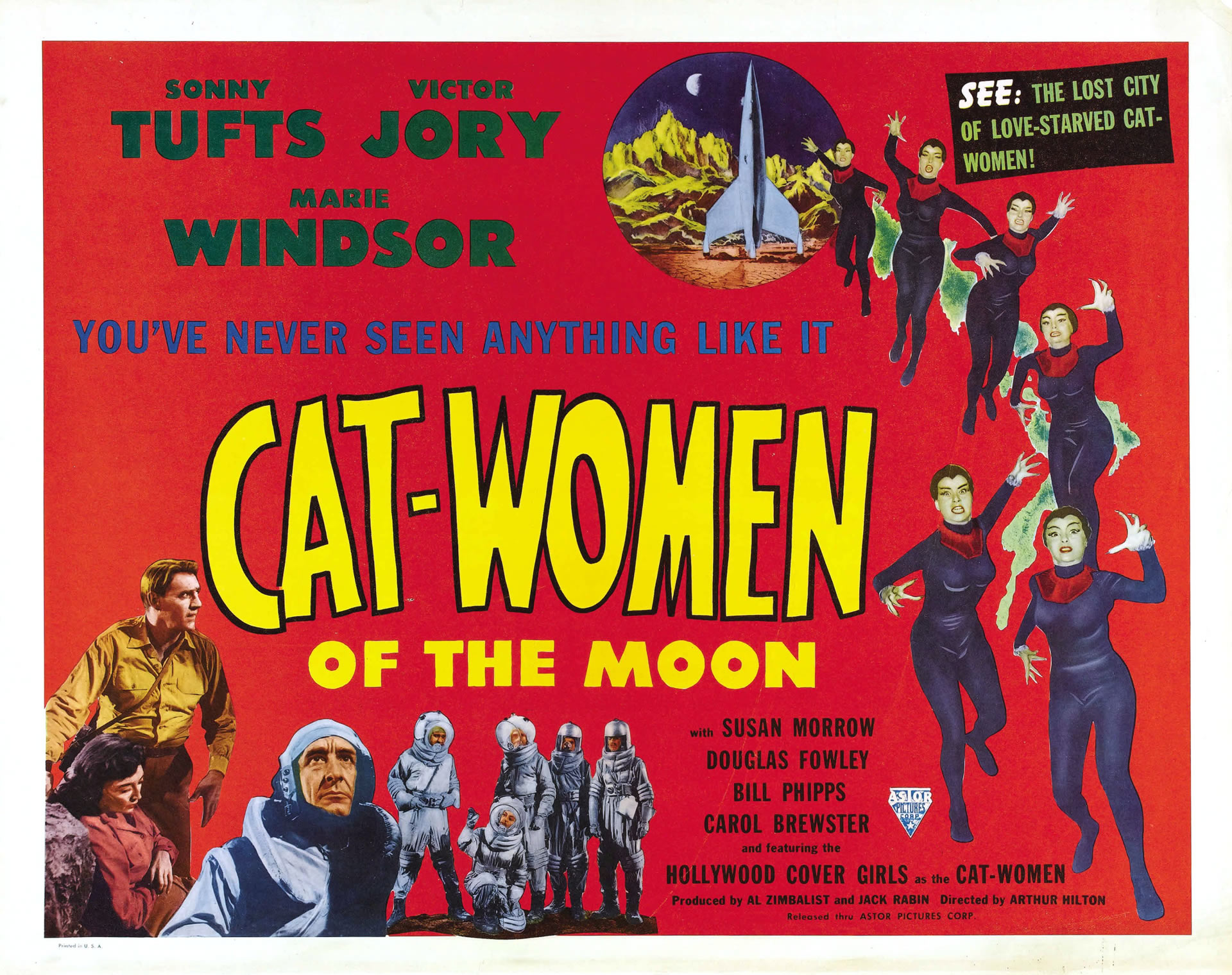
  • Cat-Women of the Moon: Lunar Glamour, Giant Spiders and Beautiful Trouble

    Cat-Women of the Moon: Lunar Glamour, Giant Spiders and Beautiful Trouble

    Promotional poster for Cat-Women of the Moon from 1953
    1953 Astor Pictures promotional artwork · Public domain in the United States

    The Pink Room Picture Show

    The moon is full of beautiful trouble.

    Moon Rocket 4 expected rocks, craters and silence. It found telepathic women in black, giant spiders and a civilization planning to steal the ride home.

    1953Science Fiction 64 MinutesBlack & White Originally in 3-D

    Hello, my darlings. Some motion pictures promise the moon. Cat-Women of the Moon actually takes us there—then fills it with glamour, telepathy, giant spiders, romantic confusion and a plan to steal a rocket.

    Released in 1953, this wonderfully strange atomic-age fantasy refuses to behave sensibly. It is pulpy, stylish, occasionally ridiculous and far more interesting than its reputation as a simple “bad movie” suggests. This is not hard science fiction. It is a lunar fever dream built for audiences who wanted to put on their 3-D glasses and discover what beautiful trouble might be waiting beyond Earth.

    In other words, it belongs in the Pink Room.

    Watch the complete movie with Veronica in the Pink Room

    Title
    Cat-Women of the Moon
    Release
    1953
    Directed by
    Arthur Hilton
    Written by
    Roy Hamilton
    Starring
    Sonny Tufts, Victor Jory and Marie Windsor
    Music by
    Elmer Bernstein
    Produced by
    Al Zimbalist and Jack Rabin
    Runtime
    64 minutes

    Moon Rocket 4 Has a Problem

    The first American expedition to the moon carries Commander Laird Grainger, co-pilot Kip Reisner, navigator Helen Salinger, engineer Walter Wallace and radio operator Doug Smith. Before they even land, Helen seems to know things she should not know. She guides the mission toward a valley on the moon’s dark side without consulting her charts.

    Once the astronauts enter a cavern and discover breathable air, the movie abandons caution entirely. The helmets come off. Giant spiders arrive. A hidden lunar city appears. Helen’s strange behavior leads the crew directly toward the women who have been calling her through telepathy.

    These are the cat-women: survivors of a dying civilization led by Alpha. Their atmosphere is failing, their world is disappearing and Moon Rocket 4 may be their only chance to escape. They do not merely want assistance. They intend to take the ship, travel to Earth and put themselves in charge.

    The dark side of the moon is considerably more glamorous than anyone at Mission Control expected.

    Science Fiction Dressed for a Night Out

    The cat-women do not look like the final survivors of a collapsing lunar society. They look as though someone interrupted a very exclusive cocktail party. Sleek black costumes, choreographed movement, sculpted hair and theatrical makeup turn the moon into a stage.

    That contradiction is part of the charm. The movie is not attempting to show us a plausible extraterrestrial civilization. It is selling fantasy: mysterious chambers, women with mental powers and Earth men who become distracted by beauty, romance, jealousy or a cave filled with gold.

    The moon becomes a place where every 1950s anxiety can perform at once. Space travel is exciting but dangerous. Advanced women are alluring but threatening. Technology offers salvation but can be stolen. Even the brave men chosen for humanity’s first lunar mission are remarkably easy to manipulate once desire, ego and greed enter the room.

    The title presents the cat-women as the danger, but the astronauts bring plenty of weaknesses with them.

    Made for the 3-D Craze

    Cat-Women of the Moon arrived during Hollywood’s early-1950s fascination with 3-D. Although most viewers now encounter a flat version, the production was deliberately staged for depth and spectacle. Contemporary exhibition records preserved by the American Film Institute show that prints were offered for conventional, 3-D and widescreen presentation.

    That explains the movie’s most enthusiastic visual choices: weapons pointed toward the camera, cavernous spaces, movement aimed into the audience and enormous lunar spiders that exist largely to make people lean backward in their seats.

    The production also carries more talent than its modest reputation suggests. Marie Windsor gives Helen precisely the cool, unreadable quality the role needs. Sonny Tufts plays Commander Laird Grainger, Victor Jory is the suspicious Kip Reisner, and the supporting company includes Susan Morrow, Douglas Fowley, William Phipps, Carol Brewster, Suzanne Alexander and the Hollywood Cover Girls.

    The score was composed and conducted by Elmer Bernstein, years before his music became inseparable from pictures such as The Magnificent Seven and The Great Escape. Even this tiny lunar adventure received music from a composer destined to become one of Hollywood’s great names.

    A Tiny Movie With a Long Shadow

    At only 64 minutes, the story moves with the efficiency of a comic book. It launches a rocket, lands on the moon, introduces monsters and a lost civilization, creates a romantic triangle, uncovers a plan to conquer Earth and races toward its conclusion before disbelief can catch up.

    The concept proved durable enough to return. Astor Pictures remade the story as Missile to the Moon, expanding and rearranging the details while preserving the irresistible central idea of astronauts discovering a hidden society beneath the lunar surface.

    But the original possesses its own handmade magic. The caves feel theatrical. The science is questionable. The giant spiders are gloriously unconvincing. None of that prevents the picture from creating a peculiar atmosphere. It resembles an illustrated pulp cover brought to life—imperfectly, enthusiastically and without the slightest fear of being too much.

    Why It Still Belongs in the Pink Room

    There is a tendency to treat movies like this as disposable camp, something to mock from a safe modern distance. That is far less interesting than meeting the film on its own terms.

    This was a picture made to provide spectacle on limited resources. It appeared while Americans were fascinated by rockets, atomic power, flying saucers, television and the possibility that another world might be close enough to reach. It wrapped those ideas in glamour and gender panic, then sent the entire package to the moon in 3-D.

    Does it make sense? Not especially. Does it entertain? Absolutely.

    The best cult films create worlds larger than their budgets. Cat-Women of the Moon gives us a dying lunar civilization, telepathic invaders, enormous spiders, gold-filled caverns, doomed romance and an interplanetary power struggle in barely more than an hour. It is audacious, stylish in its own strange way and completely sincere about its absurdity.

    That sincerity is what makes it lovable.

    Sources & Further Reading

    Keep an eye on your rocket, my darling—and never underestimate a beautifully dressed woman who already knows what you are thinking.

    VeronicaTot Comics · Because Comics Deserve Couture Too

  • The Phantom Planet: Miniature Worlds, Alien Monsters and Retro Sci-Fi Wonder

    The Phantom Planet: Miniature Worlds, Alien Monsters and Retro Sci-Fi Wonder

    The Pink Room Picture Show

    A vanished spacecraft. An invisible world. A miniature civilization.

    The wonderfully strange 1961 space adventure where enormous imagination matters far more than the size of the budget.

    1961Science Fiction82 MinutesBlack & WhitePublic Domain in the U.S.
    VeronicaTot aboard a retro spaceship for The Phantom Planet Pink Room Picture Show

    Hello, my darlings—and welcome to a vanished spacecraft, an invisible wandering world and an astronaut reduced to the size of its inhabitants. The Phantom Planet is exactly the sort of gloriously strange space-age adventure that belongs inside the Pink Room.

    Watch the complete movie with Veronica in the Pink Room

    Title
    The Phantom Planet
    Release
    1961
    Director
    William Marshall
    Producer
    Fred Gebhardt
    Starring
    Dean Fredericks, Coleen Gray, Anthony Dexter, Dolores Faith and Francis X. Bushman
    Runtime
    Approximately 82 minutes

    Welcome to a World That Should Not Exist

    In the future imagined by 1961, the United States has established bases on the Moon and is preparing for a mission to Mars. Yet spacecraft have begun disappearing without explanation. Captain Frank Chapman and Lieutenant Ray Makonnen are sent to investigate, only to encounter the mysterious object responsible for the vanished ships.

    Chapman survives a crash on the wandering world of Rheton, but its atmosphere changes him. The towering astronaut is reduced to the same miniature scale as the planet’s inhabitants. Cut off from Earth and declared a citizen of Rheton, he becomes entangled in the planet’s politics, rivalries and desperate struggle for survival.

    The Wonderful Logic of Rheton

    Rheton is less a conventional planet than a cosmic fugitive. Its people use gravity technology to move their world through space, hiding from enemies and drawing unfortunate travelers toward its surface. The film offers caves, glowing machinery, hand-operated gravity controls and a society that feels equal parts ancient court and futuristic colony.

    That collision of ideas gives The Phantom Planet its peculiar charm. The production may be modest, but its imagination is enormous. One scene suggests solemn space opera; the next introduces a miniature gladiatorial contest with a wishbone-shaped combat rod. The movie commits completely to its invented world, and that sincerity makes the oddest details irresistible.

    A tiny world, an enormous monster and enough imagination to fill the entire cosmos.

    Romance, Rivalry and a Silent Mystery

    Chapman quickly attracts the attention of Liara, played by Coleen Gray, while provoking the jealousy of Anthony Dexter’s Herron. Their rivalry places the Earthman inside a romantic and political triangle before he has fully understood the laws of his new home.

    Dolores Faith brings an especially haunting presence to Zetha, a silent young woman whose connection with Chapman gives the film some of its gentlest moments. Around them stands Sessom, the Rheton leader played by silent-screen legend Francis X. Bushman. Bushman lends the tiny civilization a surprising dignity, treating every extraordinary development as a matter of genuine consequence.

    Enter the Solarite

    No phantom planet would be complete without a monster. Rheton’s most memorable threat is the Solarite, a hulking alien creature played by Richard Kiel in his first credited film appearance. Kiel would later become famous around the world as Jaws in the James Bond films, but here he is hidden beneath a mask and transformed into a towering menace.

    The Solarite does not dominate the running time, yet its presence gives the film the creature-feature energy promised by its poster. Against Rheton’s miniature inhabitants, the monster appears enormous—an invading force that turns the planet’s gravity experiments into a fight for survival.

    Space-Age Ingenuity on a Drive-In Budget

    Director William Marshall and producer Fred Gebhardt build their future from models, optical effects, painted stars, repurposed equipment and a great deal of confidence. The spacecraft interiors, helmets, oxygen packs and some effects material had previously appeared in the television series Men into Space, a practical bit of recycling that helped the independent production create a much larger universe than its budget might suggest.

    The miniature rockets and visible wires are not flaws to hide from; they are part of the pleasure. Classic science fiction invites us to see the craftsmanship. We recognize the model as a model and still choose to believe it is racing through space. That shared act of imagination is one of the reasons these films remain so comforting.

    Why It Belongs in the Pink Room

    The Phantom Planet combines nearly every ingredient a Pink Room science-fiction night needs: doomed astronauts, secret worlds, glamorous aliens, romantic complications, strange technology, a famous future monster actor and a finale that reaches for cosmic spectacle.

    It is earnest without being dull, strange without becoming inaccessible and ambitious far beyond its resources. Most importantly, it understands that science fiction does not need perfect effects to transport an audience. It needs a door—and the courage to open it.

    Dim the lights, settle in and keep watching the skies, my darlings. The Pink Room is leaving Earth tonight.

    Sources & Further Reading

    The stars are waiting, my darling. Shall we choose another picture?

    VeronicaTot Comics · Because Comics Deserve Couture Too

  • Teenagers from Outer Space: Ray Guns, Romance and a Giant Space Lobster

    Teenagers from Outer Space: Ray Guns, Romance and a Giant Space Lobster

    Original theatrical poster for Teenagers from Outer Space
    Original 1959 theatrical poster artwork by Reynold Brown · Public domain

    The Pink Room Picture Show

    Ray guns. Romance. One giant space lobster.

    Welcome to the wonderfully strange world of Teenagers from Outer Space—where alien invaders arrive with skeleton-making ray guns, Earth is selected as a grazing field, and compassion may be the most rebellious force in the universe.

    1959 Science Fiction 85 Minutes Black & White Public Domain in the U.S.

    Hello, my darlings—and welcome back to the Pink Room Picture Show. Tonight’s transmission brings us one of those irresistible little films that could only have come from the fearless, resourceful, ray-gun-loving imagination of 1950s science fiction.

    Teenagers from Outer Space has everything a proper cult classic needs: earnest aliens, doomed romance, ruthless authority figures, a heroic act of rebellion, a disintegration ray that leaves remarkably tidy skeletons behind, and a “gargon” that must be seen to be believed.

    It is inexpensive, sincere, occasionally bonkers, and completely committed to its own universe. That combination gives the movie a charm no giant budget could manufacture.

    Watch the complete movie with Veronica in the Pink Room

    Title
    Teenagers from Outer Space
    Release
    June 20, 1959
    Written, produced & directed by
    Tom Graeff
    Starring
    David Love, Dawn Anderson, Bryan Grant and Harvey B. Dunn
    Genre
    Independent science fiction
    Runtime
    Approximately 85 minutes

    They Came Looking for Grazing Land

    A group of young extraterrestrials lands on Earth with a practical—and absolutely horrifying—proposal. Their leaders are searching for a planet where they can raise gargons, lobster-like creatures that serve as a food source but grow into enormous, dangerous beasts.

    Most of the crew treats Earth and its inhabitants as disposable. Derek, played by David Love, does not. When the merciless Thor demonstrates his ray gun on an innocent dog, Derek recognizes the cruelty at the heart of the mission. He breaks with his people and runs, carrying with him information that could determine Earth’s fate.

    His escape brings him to Betty Morgan, played by Dawn Anderson, and her grandfather. Betty’s kindness gives Derek his first real experience of human warmth, while Thor follows close behind with a ray gun, a very bad attitude, and no patience whatsoever for Earth customs.

    Underneath the ray guns and giant lobster, this is a story about choosing compassion when everyone around you has chosen cruelty.

    The One-Man Science-Fiction Studio

    The extraordinary figure behind the film was Tom Graeff, who received the onscreen credit “Written, Produced and Directed by Tom Graeff.” His involvement did not end there. Contemporary trade coverage also credited him with editing, camera work, sound and music supervision, and some of the special effects. He even appeared in the film as reporter Joe Rogers under another credited name.

    That helps explain the movie’s unusual unity. However limited the resources may have been, the film feels like the product of one determined imagination. Graeff did not wait for ideal conditions, a lavish studio, or a mountain of money. He found a way to make the picture.

    That ingenuity is part of the pleasure. The alien uniforms are simple. The ray-gun effect is direct and memorable. Familiar California locations are asked to stand in for a world under extraterrestrial threat. Every dollar is pushed on screen and then politely asked to perform two additional jobs.

    We Must Discuss the Gargon

    The gargon begins as a lobster-sized creature and, under Earth’s conditions, grows toward monstrous proportions. The effect is achieved with a very real lobster enlarged into the landscape, transforming an ordinary crustacean into an extinction-level inconvenience.

    Is it convincing? My darling, that is not the correct question.

    The correct question is whether a giant lobster rampaging through a solemn alien melodrama makes the movie more memorable. The answer is an enthusiastic yes. The gargon is exactly the kind of fearless, handmade movie magic the Pink Room was built to celebrate.

    Betty, Derek and the Heart of the Movie

    David Love plays Derek with an earnestness that keeps the character from becoming a joke. Derek is horrified by the casual violence of his own people and fascinated by humanity’s capacity for affection. His relationship with Betty gives the film its emotional center.

    Dawn Anderson’s Betty is warm, openhearted, and refreshingly active in the story. She helps Derek understand Earth rather than merely waiting to be rescued. And yes, we must acknowledge the obvious: Betty’s hair is magnificent. Even during an alien emergency, that woman is camera-ready.

    The sweetness between them gives the final act weight. Without it, the movie would simply be a collection of charming effects and stern extraterrestrial declarations. With it, Teenagers from Outer Space becomes a small tragedy about belonging, sacrifice, and the home we choose for ourselves.

    Why It Belongs in the Pink Room

    The Pink Room Picture Show exists for movies like this—not because they are flawless, but because they are alive with personality. Teenagers from Outer Space reaches far beyond its resources. It wants romance, terror, social rebellion, alien spectacle, and a creature feature all at once.

    There is also something deeply appealing about a film made through sheer determination. Comic books have always understood this spirit. A handful of creators, a limited budget, a wild premise, and the confidence to build a universe anyway—that is where cult favorites are born.

    So settle in, keep one eye on the sky, and do not trust any lobster behaving suspiciously. The Pink Room has received an alien transmission, and this one comes with fabulous hair.

    Sources & Further Reading

    Enjoyed the transmission? There are more strange worlds waiting beyond the portal.

    VeronicaTot Comics · Because Comics Deserve Couture Too