
The Pink Room Picture Show
The moon is full of beautiful trouble.
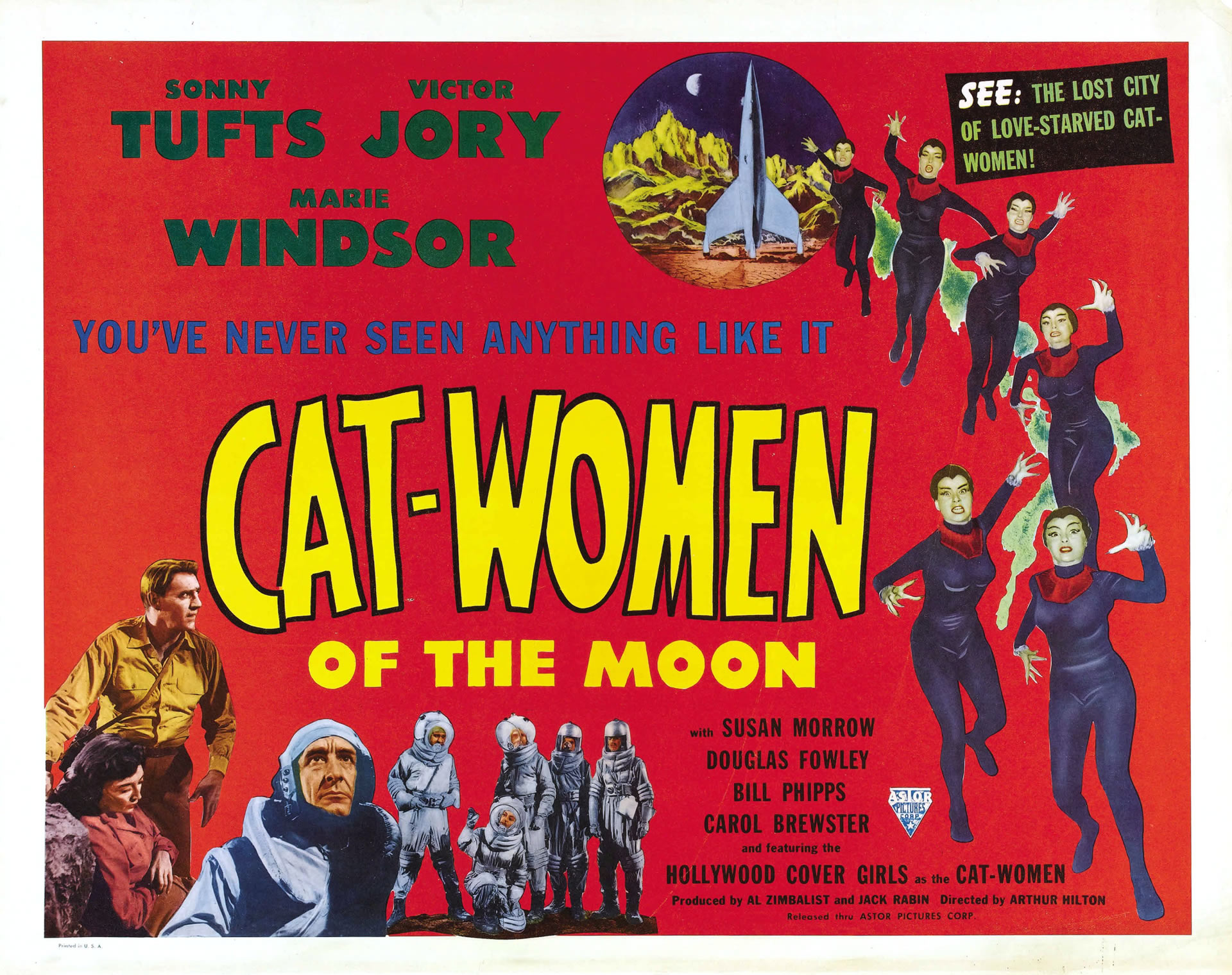
Moon Rocket 4 expected rocks, craters and silence. It found telepathic women in black, giant spiders and a civilization planning to steal the ride home.
Hello, my darlings. Some motion pictures promise the moon. Cat-Women of the Moon actually takes us there—then fills it with glamour, telepathy, giant spiders, romantic confusion and a plan to steal a rocket.
Released in 1953, this wonderfully strange atomic-age fantasy refuses to behave sensibly. It is pulpy, stylish, occasionally ridiculous and far more interesting than its reputation as a simple “bad movie” suggests. This is not hard science fiction. It is a lunar fever dream built for audiences who wanted to put on their 3-D glasses and discover what beautiful trouble might be waiting beyond Earth.
In other words, it belongs in the Pink Room.
Watch the complete movie with Veronica in the Pink Room
- Title
- Cat-Women of the Moon
- Release
- 1953
- Directed by
- Arthur Hilton
- Written by
- Roy Hamilton
- Starring
- Sonny Tufts, Victor Jory and Marie Windsor
- Music by
- Elmer Bernstein
- Produced by
- Al Zimbalist and Jack Rabin
- Runtime
- 64 minutes
Moon Rocket 4 Has a Problem
The first American expedition to the moon carries Commander Laird Grainger, co-pilot Kip Reisner, navigator Helen Salinger, engineer Walter Wallace and radio operator Doug Smith. Before they even land, Helen seems to know things she should not know. She guides the mission toward a valley on the moon’s dark side without consulting her charts.
Once the astronauts enter a cavern and discover breathable air, the movie abandons caution entirely. The helmets come off. Giant spiders arrive. A hidden lunar city appears. Helen’s strange behavior leads the crew directly toward the women who have been calling her through telepathy.
These are the cat-women: survivors of a dying civilization led by Alpha. Their atmosphere is failing, their world is disappearing and Moon Rocket 4 may be their only chance to escape. They do not merely want assistance. They intend to take the ship, travel to Earth and put themselves in charge.
The dark side of the moon is considerably more glamorous than anyone at Mission Control expected.
Science Fiction Dressed for a Night Out
The cat-women do not look like the final survivors of a collapsing lunar society. They look as though someone interrupted a very exclusive cocktail party. Sleek black costumes, choreographed movement, sculpted hair and theatrical makeup turn the moon into a stage.
That contradiction is part of the charm. The movie is not attempting to show us a plausible extraterrestrial civilization. It is selling fantasy: mysterious chambers, women with mental powers and Earth men who become distracted by beauty, romance, jealousy or a cave filled with gold.
The moon becomes a place where every 1950s anxiety can perform at once. Space travel is exciting but dangerous. Advanced women are alluring but threatening. Technology offers salvation but can be stolen. Even the brave men chosen for humanity’s first lunar mission are remarkably easy to manipulate once desire, ego and greed enter the room.
The title presents the cat-women as the danger, but the astronauts bring plenty of weaknesses with them.
Made for the 3-D Craze
Cat-Women of the Moon arrived during Hollywood’s early-1950s fascination with 3-D. Although most viewers now encounter a flat version, the production was deliberately staged for depth and spectacle. Contemporary exhibition records preserved by the American Film Institute show that prints were offered for conventional, 3-D and widescreen presentation.
That explains the movie’s most enthusiastic visual choices: weapons pointed toward the camera, cavernous spaces, movement aimed into the audience and enormous lunar spiders that exist largely to make people lean backward in their seats.
The production also carries more talent than its modest reputation suggests. Marie Windsor gives Helen precisely the cool, unreadable quality the role needs. Sonny Tufts plays Commander Laird Grainger, Victor Jory is the suspicious Kip Reisner, and the supporting company includes Susan Morrow, Douglas Fowley, William Phipps, Carol Brewster, Suzanne Alexander and the Hollywood Cover Girls.
The score was composed and conducted by Elmer Bernstein, years before his music became inseparable from pictures such as The Magnificent Seven and The Great Escape. Even this tiny lunar adventure received music from a composer destined to become one of Hollywood’s great names.
A Tiny Movie With a Long Shadow
At only 64 minutes, the story moves with the efficiency of a comic book. It launches a rocket, lands on the moon, introduces monsters and a lost civilization, creates a romantic triangle, uncovers a plan to conquer Earth and races toward its conclusion before disbelief can catch up.
The concept proved durable enough to return. Astor Pictures remade the story as Missile to the Moon, expanding and rearranging the details while preserving the irresistible central idea of astronauts discovering a hidden society beneath the lunar surface.
But the original possesses its own handmade magic. The caves feel theatrical. The science is questionable. The giant spiders are gloriously unconvincing. None of that prevents the picture from creating a peculiar atmosphere. It resembles an illustrated pulp cover brought to life—imperfectly, enthusiastically and without the slightest fear of being too much.
Why It Still Belongs in the Pink Room
There is a tendency to treat movies like this as disposable camp, something to mock from a safe modern distance. That is far less interesting than meeting the film on its own terms.
This was a picture made to provide spectacle on limited resources. It appeared while Americans were fascinated by rockets, atomic power, flying saucers, television and the possibility that another world might be close enough to reach. It wrapped those ideas in glamour and gender panic, then sent the entire package to the moon in 3-D.
Does it make sense? Not especially. Does it entertain? Absolutely.
The best cult films create worlds larger than their budgets. Cat-Women of the Moon gives us a dying lunar civilization, telepathic invaders, enormous spiders, gold-filled caverns, doomed romance and an interplanetary power struggle in barely more than an hour. It is audacious, stylish in its own strange way and completely sincere about its absurdity.
That sincerity is what makes it lovable.
Sources & Further Reading
- AFI Catalog: Cat-Women of the Moon — production credits, cast, runtime, synopsis and exhibition history.
- Wikimedia Commons promotional poster record — original artwork and U.S. public-domain information.
- Internet Archive film record — preserved public-domain copy.
_poster_1.jpg)
Keep an eye on your rocket, my darling—and never underestimate a beautifully dressed woman who already knows what you are thinking.
VeronicaTot Comics · Because Comics Deserve Couture Too
Leave a Reply