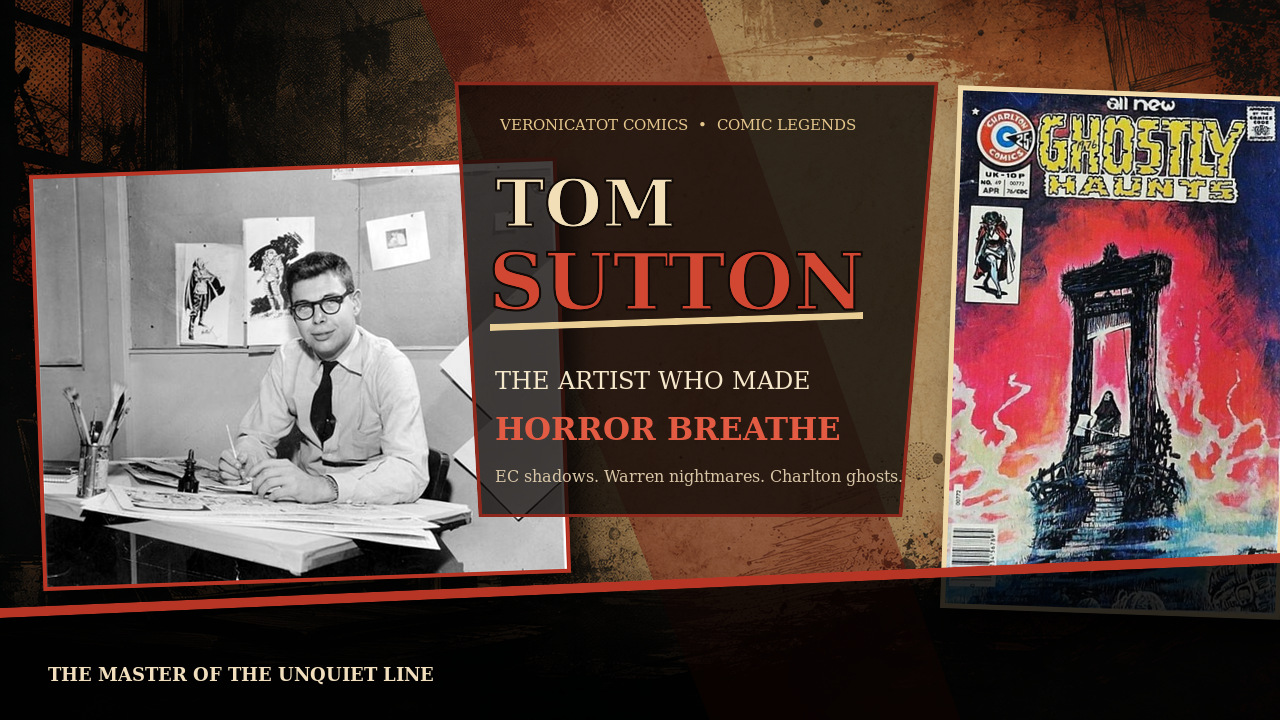
Some artists draw monsters. Tom Sutton made you suspect the monsters had been there before he arrived—and might still be there after you closed the book.
Hello, my darlings.
There is a copy of Ghostly Haunts #49 that keeps pulling me back. It is not a superhero key. There is no celebrated first appearance waiting inside to turn every price guide upside down. What it has is a painted cover by Tom Sutton: a guillotine rising from a feverish red inferno, a lonely hooded figure beneath its blade, and just enough cold blue at the bottom to make the whole scene feel even more impossible.
A guillotine is rarely what one calls tasteful décor, but Sutton makes a persuasive case.
That April 1976 cover explains his appeal better than a tidy checklist ever could. Sutton’s pictures do not simply illustrate horror. They seem to absorb it. His shadows feel damp. His machinery looks overworked. His rooms appear to remember every terrible thing that happened inside them. Even when the story is quiet, the page is never entirely at rest.
This is the story of an artist who moved through Westerns, horror, science fiction, licensed properties, underground work, and nearly every corner of the comics business without ever becoming easy to categorize. Tom Sutton was not polished in the conventional superhero sense. He was better suited to stranger territory.
He could turn an empty corner into a place where even the wallpaper had motives.
Before the Monsters: North Adams, EC Comics, and a Drawing Table
Thomas F. Sutton was born in 1937 and grew up in North Adams, Massachusetts, a New England mill town whose brick factories and long winters sound, in retrospect, almost suspiciously well cast for the beginning of a horror artist’s life.
Drawing became both fascination and refuge. Sutton devoured newspaper strips and comic books, but EC Comics supplied the great revelation. The science-fiction, horror, and war titles associated with artists such as Johnny Craig, Graham Ingels, Wally Wood, and Will Elder showed him how sophisticated commercial comics could be. In a lengthy interview with Gary Groth, Sutton remembered believing that another creative flowering like EC was bound to happen—and wanting to help make it happen.
That expectation would follow him through his career. Publishers often wanted pages completed quickly and inexpensively. Sutton wanted atmosphere, invention, and the freedom to draw the peculiar machinery lurking in the back of his mind. The tension between those two desires is visible throughout his work.
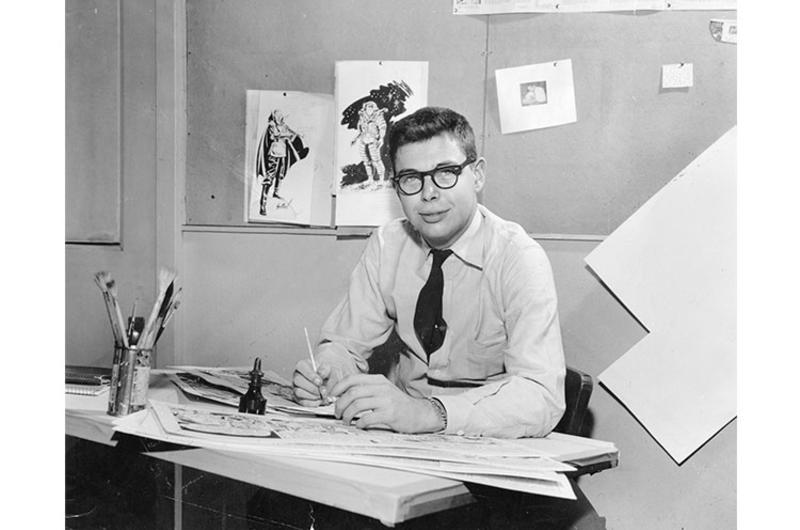
As a boy, Sutton received a sturdy drafting table from his father. Decades later, he was still using it. That detail feels beautifully appropriate: publishers changed, formats disappeared, and entire genres fell in and out of fashion, but Sutton kept returning to the table.
His Real Art School Was in Tokyo
Sutton joined the United States Air Force in 1955 and was stationed in Japan. He eventually landed at the Tokyo office of Stars and Stripes, where he created the daily science-fiction strip Johnny Craig. The title honored one of his favorite EC artists, while the story followed a rocket pilot searching for a second Earth in the distant year of 2058.
It was a formidable apprenticeship. Sutton had to draw on deadline, solve visual problems quickly, and learn beside experienced magazine artists. He later described Stars and Stripes as his art school. It is difficult to imagine a better preparation for comic books: tell the story, make the deadline, and do not wait for inspiration to send a formal invitation.
When Sutton eventually brought examples of that work to Marvel, Stan Lee was impressed that the young artist had already produced a daily strip for two years. Sutton was handed paper and Western assignments. His professional comics career is generally dated to 1967, when a backup story appeared in Rawhide Kid.
Yet superheroes were never his natural habitat. Sutton was interested in environments, atmosphere, strange technology, and the visual possibilities of fear. A clean punch across a clean panel was useful. A crumbling laboratory filled with wires, fog, and something breathing behind the wall was much more his speed.
Warren Publishing Opens the Door
Warren Publishing gave Sutton the territory he had been seeking. In magazines such as Creepy, Eerie, and Vampirella, he could use ink wash, gray tones, deep blacks, and grotesque textures that the standard color comic did not always accommodate.
His early relationship with editor and writer Archie Goodwin was especially important. Sutton remembered Goodwin as an editor who understood drawing as well as writing—someone who could suggest a change without flattening the artist’s personality. That sort of editorial intelligence mattered to Sutton because his best pages depended on rhythm. The shadows, expressions, architecture, and small background disturbances all had to arrive at precisely the right moment.
Sutton also made an essential contribution to one of Warren’s most enduring characters. Vampirella had already appeared as a cover figure, but Sutton became the first artist to draw her in an interior story in Vampirella #1. That distinction is important. He did not create Vampirella, but he helped move her from iconic cover image into sequential life.
And what a natural pairing she was with Sutton: glamorous, theatrical, strange, and surrounded by darkness that knew how to pose.

Charlton Comics and the Freedom of the Shadows
If Warren allowed Sutton to work in atmospheric black and white, Charlton Comics gave his eccentric imagination another kind of playground. The company was famously economical, operating far from the polished center of New York publishing. The rates were modest, the production could be rough, and yet artists sometimes found room there that more prestigious publishers would never have granted them.
Sutton became one of the defining visual voices of Charlton horror. His work appeared in titles including Ghostly Haunts, Ghost Manor, Midnight Tales, and The Many Ghosts of Doctor Graves. He wrote and drew stories, rendered horror hosts, filled panels with occult laboratories and ancient rooms, and created painted covers that looked less like sales displays than recovered evidence.
His Charlton work could be elegant and grotesque in the same panel. Faces stretched toward caricature, but the emotion remained convincing. Backgrounds accumulated scratchy marks and anxious detail. A figure might appear almost comical until Sutton placed it beside something genuinely dreadful. That unstable balance is a central part of his style: he knew that horror becomes more unsettling when it is allowed to grin.
Which brings us back to Ghostly Haunts #49. The issue’s cover is attributed to Sutton as a painting. It does not promise a famous new hero or a universe-changing event. It promises a mood—and then delivers one with alarming confidence.
The interior stories were produced by other creators, an important bibliographic detail, but the cover belongs unmistakably to Sutton’s world. The guillotine is too tall, the fire too vivid, the platform too precarious. Reality has been stretched just enough to become a nightmare.
Sutton did not ask whether a scene was realistic. He asked whether it felt haunted.

Planet of the Apes and Worlds Built Line by Line
Sutton’s interest in science fiction found one of its richest outlets in Marvel’s black-and-white Planet of the Apes magazine. Working with writer Doug Moench, he helped create the “Future History Chronicles,” a sequence that pushed beyond straightforward movie adaptation into elaborate new territory.
Moench and Sutton shared an enthusiasm that the artist did not always encounter in commercial assignments. Sutton admired Moench’s writing, and their collaboration encouraged the kind of dense world-building he loved: civilizations, machinery, ruins, costumes, creatures, and entire histories suggested in a few crowded panels.
Look closely at one of Sutton’s science-fiction pages and the background rarely behaves like a background. Pipes bend into darkness. Structures multiply. Machines appear to have been repaired by several generations of increasingly desperate mechanics. The setting becomes part of the cast.
That is why his science fiction and horror feel related. Whether he drew a crypt or a spacecraft, Sutton wanted the environment to possess a past. His worlds looked used, damaged, and inhabited. Nothing had just been unboxed.
Star Trek, Likenesses, and the Limits of a Licensed Universe
From 1984 through 1988, Sutton worked extensively on DC’s Star Trek comics. On paper, it sounded ideal: a science-fiction property filled with starships, alien worlds, control panels, and unexplored corners. Sutton accepted the assignment enthusiastically because he loved science fiction, even if he was not approaching it primarily as a devoted Star Trek fan.
The licensed reality proved more restrictive. Character likenesses required attention, reference materials could be inadequate, and some of the elaborate backgrounds Sutton drew were simplified or removed during production. He wanted to discover what existed beyond the television camera’s field of view. The license often wanted what viewers already recognized.
It is the perfect Sutton conflict in miniature: the artist leaning toward the unseen door while the assignment politely asks him to remain on the bridge.
Still, the run demonstrates his range and stamina. Across his career he worked for Marvel, DC, Warren, Charlton, Skywald, First, Dark Horse, and other publishers. His credits touched Westerns, superheroes, horror, science fiction, licensed entertainment, independent comics, commercial illustration, and gallery painting. He could work almost anywhere. He simply looked most at home when the lights were low.
The Beauty of the Unquiet Line
It is tempting to praise comic artists only for refinement: clean anatomy, precise perspective, handsome faces, perfect machinery. Sutton’s greatness lives somewhere less comfortable.
His line trembles, scratches, pools, and crawls. It can be lush in one panel and brutally economical in the next. His monsters are not arranged for admiration; they intrude. His human beings look vulnerable because their faces are allowed to bend under fear, greed, exhaustion, and disbelief.
The obvious ancestors are the EC artists Sutton loved, but his work never settles into imitation. There are echoes of Graham Ingels in the rot, Wally Wood in the machinery, and Will Elder in the manic density, yet Sutton’s pages remain his own—more nervous, more improvisational, and sometimes almost feverish.
That fever is precisely why the work survives changes in fashion. Smooth commercial illustration can age when the fashion it served disappears. Sutton’s pictures were never entirely fashionable to begin with. They were personal disturbances smuggled into commercial assignments.
An Artist at the Drawing Board
Tom Sutton died in May 2002 at the age of 65. Contemporary reports stated that he was found at his drawing board. It is an ending almost too perfectly composed for a legend, so it deserves to be handled without melodrama. Sutton spent his life drawing. At the end, the table was still there.
His career was not a neat ascent toward one famous title. It was a long, unruly passage through the less predictable rooms of American comics. He could be brilliant, rushed, inventive, frustrated, hilarious, and brutally candid about the industry. Even Sutton acknowledged that the quality of his work varied. But when the material, deadline, and creative freedom aligned, very few artists could make a page feel so thoroughly possessed.
Why I Keep Returning to Ghostly Haunts #49
Collectors are trained to ask what happens inside a comic. Is it a first appearance? A major death? A scarce variant? An overlooked key?
Those questions matter, but they are not the only reasons to love a book.
Sometimes the key is the artist.
Ghostly Haunts #49 reminds me that collecting can still begin with the oldest and best response: I saw the cover, and I had to know more. Not because a database instructed me to want it. Not because a film announcement made it hotter overnight. Because one image created a whole world before I ever opened the book.
That is Tom Sutton’s gift. He makes us curious about the darkness. He gives the darkness architecture, texture, and a rather suspicious sense of humor. Then he leaves the door open.
It is eerie. It is captivating. It is Sutton.
With love from the Pink Room,
Ronnie 💋
Research and Further Reading
- “An Odd Man Out: Tom Sutton,” Gary Groth’s extensive interview in The Comics Journal
- “Tom Sutton, Artist,” Stars and Stripes historical archive
- Ghostly Haunts #49 issue record and cover attribution, Charlton Tales
- “To Thomas, On His 78th Birthday,” StarWarp Concepts
- Tom Sutton obituary and career overview, Diamond Comics
Cover and interior artwork discussed in this editorial remain the property of their respective rights holders and are presented for identification, criticism, historical discussion, and commentary.
Leave a Reply