Author: Ronnie

  • The Little Shop of Horrors: Roger Corman’s Hungry Plant and Cult-Movie Chaos

    The Little Shop of Horrors: Roger Corman’s Hungry Plant and Cult-Movie Chaos

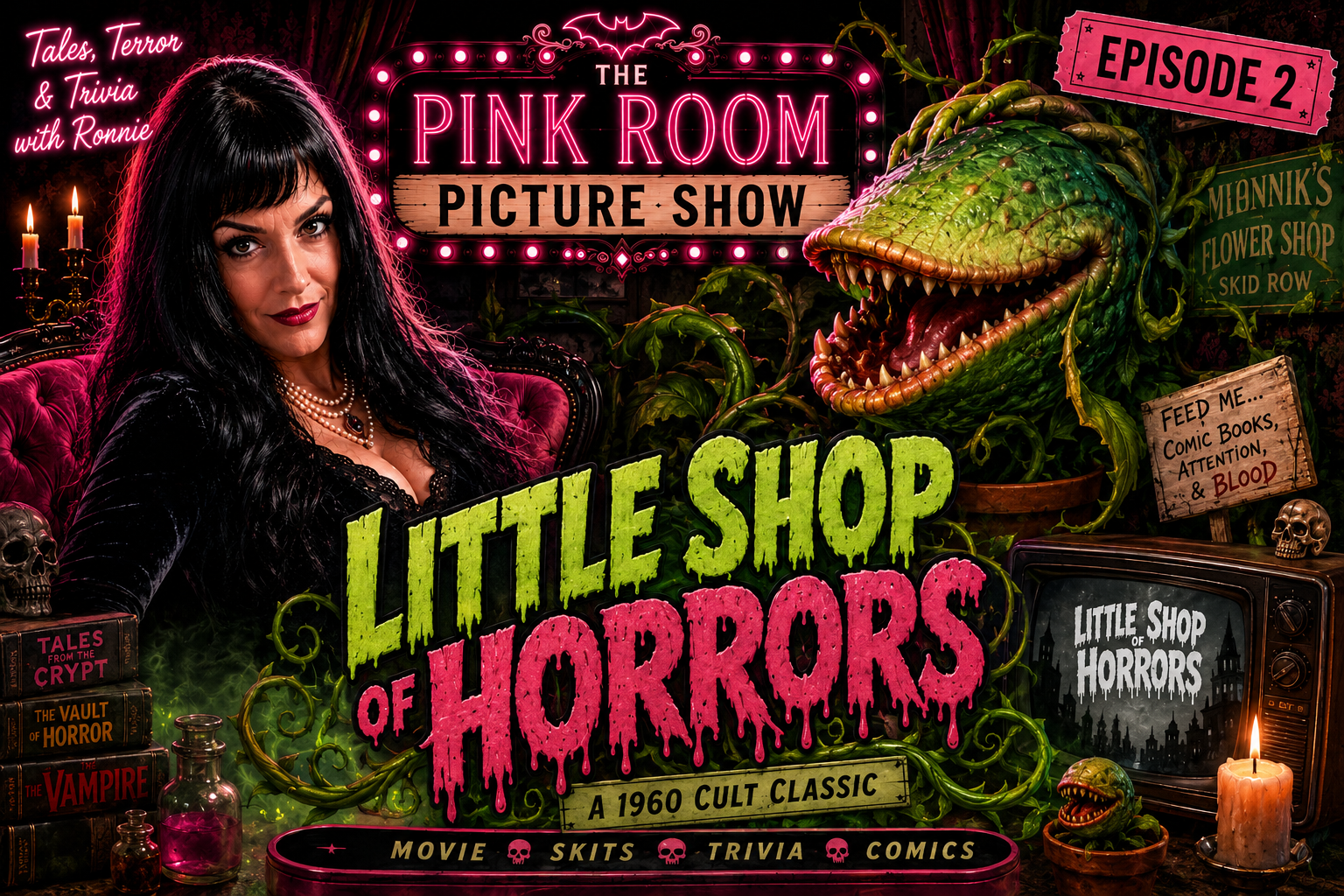
    VeronicaTot with a giant carnivorous plant for Little Shop of Horrors in The Pink Room Picture Show

    The Pink Room Picture Show · Episode 2

    Flowers, murder and one very hungry plant.

    Roger Corman’s gloriously odd horror comedy turns a shabby flower shop into the most dangerous attraction on Skid Row.

    1960Horror Comedy70 MinutesBlack & WhitePublic Domain in the U.S.

    Hello, my darlings—and welcome to Mushnick’s Flower Shop, where business is wilting, romance is awkward and the newest plant on display has an appetite no amount of fertilizer can satisfy.

    The Little Shop of Horrors is Roger Corman at his fastest, strangest and most playful: a black comedy assembled with B-movie ingenuity, populated by lovable eccentrics and powered by the increasingly desperate question of what poor Seymour will feed Audrey Junior next.

    Watch the complete movie with Veronica in the Pink Room

    Title
    The Little Shop of Horrors
    Release
    1960
    Director & producer
    Roger Corman
    Writer
    Charles B. Griffith
    Starring
    Jonathan Haze, Jackie Joseph, Mel Welles and Dick Miller
    Runtime
    70 minutes

    A Flower Shop on the Edge of Disaster

    Seymour Krelboined works for Gravis Mushnick, the perpetually exasperated owner of a failing Skid Row flower shop. Seymour is clumsy, nervous and hopelessly in love with his co-worker Audrey Fulquard. His one chance to prove himself arrives in the form of a peculiar plant he has raised from an unidentified seed.

    The strange little specimen draws customers and saves Seymour’s job, but it soon reveals the flaw in this promising arrangement: ordinary plant food will not do. Audrey Junior wants blood. As the plant grows, so does its voice, its appetite and Seymour’s panic.

    Feed me. Feed me. I’m hungry!

    Roger Corman’s Two-Day Miracle

    The production has become legendary for its speed. Corman reused sets left standing from A Bucket of Blood, rehearsed quickly and photographed the story with the efficiency that made him the king of independent filmmaking. The result does not feel cautious or overworked. It moves with the cheerful recklessness of everyone involved knowing they have very little time and deciding to make that part of the fun.

    Charles B. Griffith’s screenplay treats reality as optional. Characters misunderstand one another, jokes arrive from unexpected directions and the film leaps from romance to murder to police parody without asking permission. Its handmade energy is not something a polished remake could reproduce. This movie is alive in precisely the same unruly way as Audrey Junior.

    Seymour, Audrey and Mushnick

    Jonathan Haze makes Seymour both ridiculous and oddly sympathetic. He is not a criminal mastermind; he is a frightened young man whose attempts to solve one problem create three more. Jackie Joseph gives Audrey a sweet sincerity that keeps the romance from disappearing beneath the farce, while Mel Welles turns Mushnick’s outrage into a wonderfully elastic comic performance.

    The flower shop becomes a stage for an entire neighborhood of eccentrics. Dick Miller appears as Burson Fouch, a customer who eats flowers as casually as other people eat candy. Myrtle Vail nearly steals the picture as Seymour’s spectacularly hypochondriacal mother, who treats every ailment like a cherished hobby.

    A Young Jack Nicholson Goes to the Dentist

    The film’s most famous detour belongs to Jack Nicholson as Wilbur Force, a gleefully masochistic dental patient. He appears only briefly, but the performance is unmistakable: the grin, the manic timing and the feeling that this young actor has discovered a private joke no one else in the room fully understands.

    The dental sequence has little interest in advancing the plant story. It exists because it is funny, strange and perfectly suited to the movie’s crooked universe. That freedom is one of the film’s greatest pleasures.

    From Tiny Production to Cult Institution

    The movie’s afterlife grew far beyond its modest beginnings. It became a favorite at midnight screenings and art houses, inspiring audiences to shout lines and participate long before interactive cult cinema became familiar. Its central idea later bloomed into the off-Broadway musical by Howard Ashman and Alan Menken and the beloved 1986 film adaptation.

    Yet the 1960 original remains its own creature. It is scrappier, darker and more absurd. Audrey Junior is less a polished star than a botanical nightmare assembled in the back room, which makes the danger feel both hilarious and strangely intimate.

    Why It Belongs in the Pink Room

    The Little Shop of Horrors understands something essential about horror comedy: the monster can be frightening, but the people surrounding it should be even stranger. It mixes old-Hollywood faces, beatnik energy, slapstick murder and a talking plant into a movie that never pauses long enough to become respectable.

    That is exactly why it belongs here. The Pink Room Picture Show celebrates movies with personality—films whose ambitions outgrew their budgets and whose oddest choices became the reason audiences still love them.

    Sources & Further Reading

    Mind the vines, my darling. Audrey Junior has noticed you.

    VeronicaTot Comics · Because Comics Deserve Couture Too
  • The Phantom Planet: Miniature Worlds, Alien Monsters and Retro Sci-Fi Wonder

    The Phantom Planet: Miniature Worlds, Alien Monsters and Retro Sci-Fi Wonder

    The Pink Room Picture Show

    A vanished spacecraft. An invisible world. A miniature civilization.

    The wonderfully strange 1961 space adventure where enormous imagination matters far more than the size of the budget.

    1961Science Fiction82 MinutesBlack & WhitePublic Domain in the U.S.
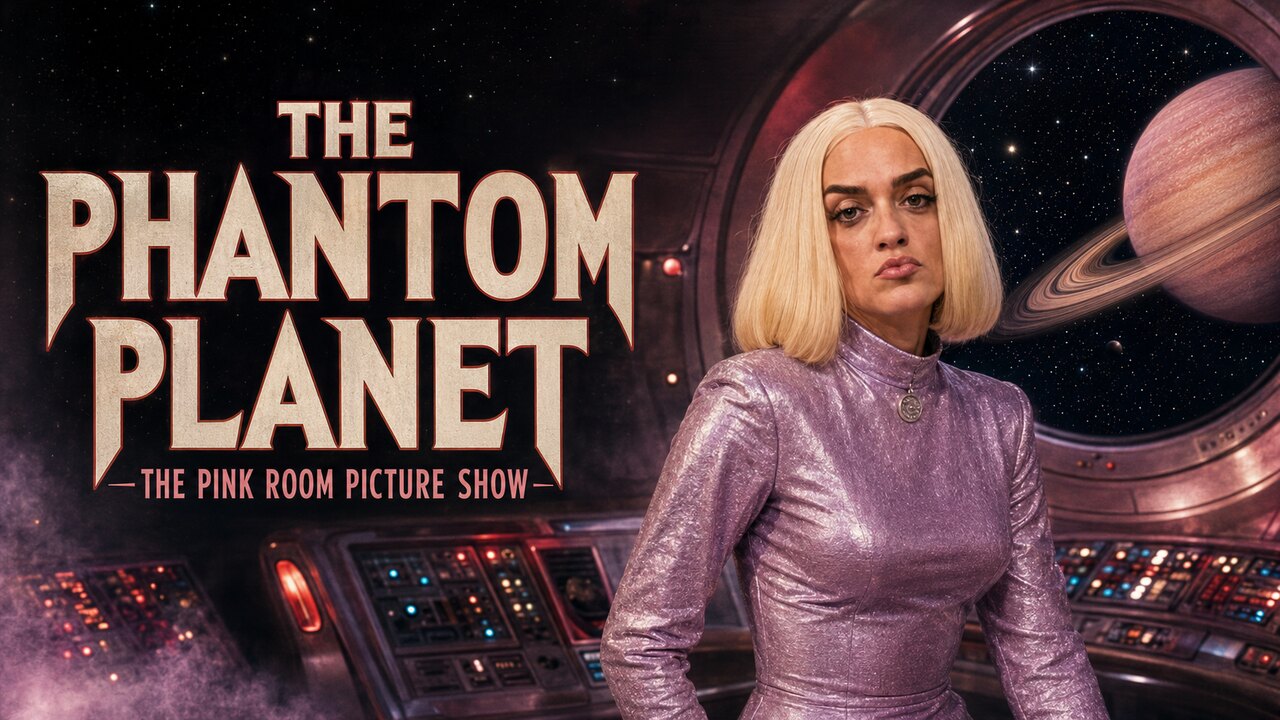
    VeronicaTot aboard a retro spaceship for The Phantom Planet Pink Room Picture Show

    Hello, my darlings—and welcome to a vanished spacecraft, an invisible wandering world and an astronaut reduced to the size of its inhabitants. The Phantom Planet is exactly the sort of gloriously strange space-age adventure that belongs inside the Pink Room.

    Watch the complete movie with Veronica in the Pink Room

    Title
    The Phantom Planet
    Release
    1961
    Director
    William Marshall
    Producer
    Fred Gebhardt
    Starring
    Dean Fredericks, Coleen Gray, Anthony Dexter, Dolores Faith and Francis X. Bushman
    Runtime
    Approximately 82 minutes

    Welcome to a World That Should Not Exist

    In the future imagined by 1961, the United States has established bases on the Moon and is preparing for a mission to Mars. Yet spacecraft have begun disappearing without explanation. Captain Frank Chapman and Lieutenant Ray Makonnen are sent to investigate, only to encounter the mysterious object responsible for the vanished ships.

    Chapman survives a crash on the wandering world of Rheton, but its atmosphere changes him. The towering astronaut is reduced to the same miniature scale as the planet’s inhabitants. Cut off from Earth and declared a citizen of Rheton, he becomes entangled in the planet’s politics, rivalries and desperate struggle for survival.

    The Wonderful Logic of Rheton

    Rheton is less a conventional planet than a cosmic fugitive. Its people use gravity technology to move their world through space, hiding from enemies and drawing unfortunate travelers toward its surface. The film offers caves, glowing machinery, hand-operated gravity controls and a society that feels equal parts ancient court and futuristic colony.

    That collision of ideas gives The Phantom Planet its peculiar charm. The production may be modest, but its imagination is enormous. One scene suggests solemn space opera; the next introduces a miniature gladiatorial contest with a wishbone-shaped combat rod. The movie commits completely to its invented world, and that sincerity makes the oddest details irresistible.

    A tiny world, an enormous monster and enough imagination to fill the entire cosmos.

    Romance, Rivalry and a Silent Mystery

    Chapman quickly attracts the attention of Liara, played by Coleen Gray, while provoking the jealousy of Anthony Dexter’s Herron. Their rivalry places the Earthman inside a romantic and political triangle before he has fully understood the laws of his new home.

    Dolores Faith brings an especially haunting presence to Zetha, a silent young woman whose connection with Chapman gives the film some of its gentlest moments. Around them stands Sessom, the Rheton leader played by silent-screen legend Francis X. Bushman. Bushman lends the tiny civilization a surprising dignity, treating every extraordinary development as a matter of genuine consequence.

    Enter the Solarite

    No phantom planet would be complete without a monster. Rheton’s most memorable threat is the Solarite, a hulking alien creature played by Richard Kiel in his first credited film appearance. Kiel would later become famous around the world as Jaws in the James Bond films, but here he is hidden beneath a mask and transformed into a towering menace.

    The Solarite does not dominate the running time, yet its presence gives the film the creature-feature energy promised by its poster. Against Rheton’s miniature inhabitants, the monster appears enormous—an invading force that turns the planet’s gravity experiments into a fight for survival.

    Space-Age Ingenuity on a Drive-In Budget

    Director William Marshall and producer Fred Gebhardt build their future from models, optical effects, painted stars, repurposed equipment and a great deal of confidence. The spacecraft interiors, helmets, oxygen packs and some effects material had previously appeared in the television series Men into Space, a practical bit of recycling that helped the independent production create a much larger universe than its budget might suggest.

    The miniature rockets and visible wires are not flaws to hide from; they are part of the pleasure. Classic science fiction invites us to see the craftsmanship. We recognize the model as a model and still choose to believe it is racing through space. That shared act of imagination is one of the reasons these films remain so comforting.

    Why It Belongs in the Pink Room

    The Phantom Planet combines nearly every ingredient a Pink Room science-fiction night needs: doomed astronauts, secret worlds, glamorous aliens, romantic complications, strange technology, a famous future monster actor and a finale that reaches for cosmic spectacle.

    It is earnest without being dull, strange without becoming inaccessible and ambitious far beyond its resources. Most importantly, it understands that science fiction does not need perfect effects to transport an audience. It needs a door—and the courage to open it.

    Dim the lights, settle in and keep watching the skies, my darlings. The Pink Room is leaving Earth tonight.

    Sources & Further Reading

    The stars are waiting, my darling. Shall we choose another picture?

    VeronicaTot Comics · Because Comics Deserve Couture Too
  • House on Haunted Hill: Vincent Price Invites You to Stay the Night

    House on Haunted Hill: Vincent Price Invites You to Stay the Night

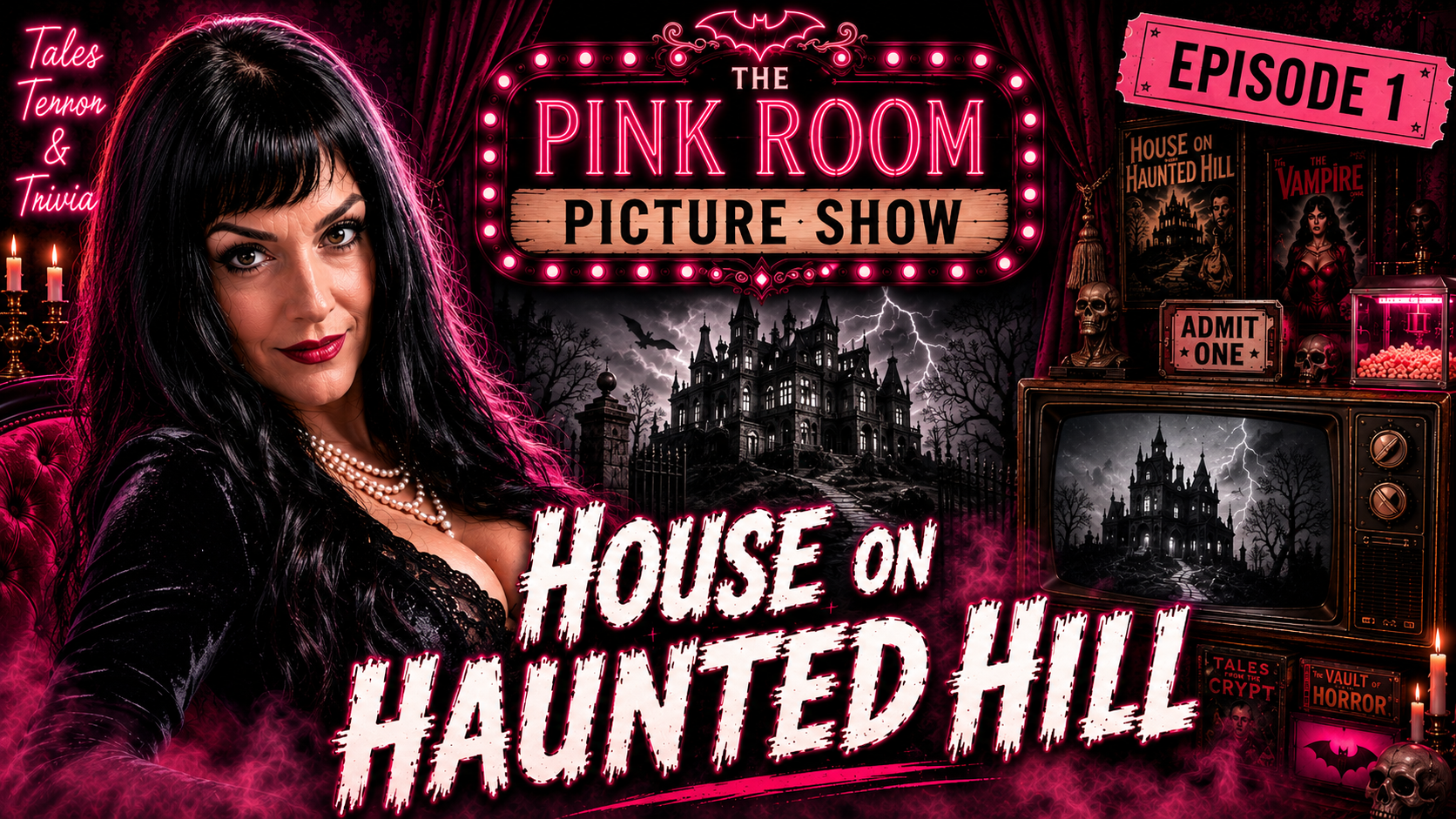
    VeronicaTot presents House on Haunted Hill in The Pink Room Picture Show

    The Pink Room Picture Show

    Five strangers. One locked house. Ten thousand dollars.

    Vincent Price invites you to the most dangerous cocktail party in horror history, where the doors lock at midnight and surviving until morning may be worth more than money.

    1959 Horror 75 Minutes Black & White Public Domain in the U.S.

    Hello, my darlings—and welcome to the house where the Pink Room Picture Show began. Before the portal, before the expanding universe and before Walter started appearing in windows, there was Vincent Price standing in the darkness with an invitation no sensible person should accept.

    House on Haunted Hill is pure William Castle showmanship: elegant, sinister, playful and always aware that a horror movie should feel like an event. It brought together Castle’s carnival-barker imagination and Vincent Price’s velvet-smooth menace, then locked them inside a mansion with five desperate strangers, a collection of loaded pistols, an acid vat and one deeply unhappy marriage.

    It was the perfect film to open the doors of the Pink Room Picture Show—and it became the episode that first showed how many viewers were waiting to come inside.

    Watch the complete movie with Veronica in the Pink Room

    Title
    House on Haunted Hill
    Release
    1959
    Produced & directed by
    William Castle
    Written by
    Robb White
    Starring
    Vincent Price, Carol Ohmart, Richard Long, Carolyn Craig and Elisha Cook Jr.
    Runtime
    75 minutes

    An Invitation from Frederick Loren

    Eccentric millionaire Frederick Loren, played with exquisite composure by Vincent Price, rents a house with a murderous reputation. He and his wife Annabelle invite five strangers to spend the night. Anyone who remains inside until morning will receive ten thousand dollars.

    The guests arrive in funeral cars. The doors lock at midnight. Each person receives a small coffin containing a loaded pistol. Before long, chandeliers fall, blood drips from ceilings, severed heads appear where no severed heads should be, and Nora Manning becomes convinced that something inside the house wants her dead.

    The delicious question is never simply whether the house is haunted. It is whether Frederick and Annabelle are more dangerous than any ghost could ever hope to be.

    Vincent Price does not merely enter a room. He makes the room understand that it now belongs to him.

    Vincent Price at His Most Delicious

    Frederick Loren is one of the roles that helped solidify Vincent Price as a horror icon. He is charming, amused and impossible to read. Every line shared with Annabelle carries the polish of a champagne glass and the edge of a razor.

    Price never needs to shout to command the picture. A lifted eyebrow can imply an entire conspiracy. A polite smile can feel more threatening than a scream. He allows the audience to enjoy Frederick’s sophistication while never letting us forget that this is a man who may have planned something dreadful.

    Opposite him, Carol Ohmart gives Annabelle exactly the right poisonous glamour. Their marriage is the film’s most convincing haunting: beautiful on the outside, dead and dangerous within.

    William Castle Makes Horror an Event

    William Castle understood that audiences did not merely buy tickets to see a movie. They bought the story surrounding the movie—the dare, the anticipation and the feeling that something might escape the screen.

    For selected first-run screenings of House on Haunted Hill, Castle created a theatrical gimmick he called Emergo. At the appropriate moment, a full-sized plastic skeleton traveled along wires above the audience. The film’s own closing credits even include the immortal line: “Skeleton by Himself.”

    It was playful, shameless and brilliant. Castle turned the entire theater into part of the attraction. Long before immersive cinema became a fashionable phrase, he understood that a memorable presentation could make a modestly budgeted movie feel enormous.

    The House That Is Never Quite the Same House

    The unforgettable exterior is Frank Lloyd Wright’s Ennis House in Los Feliz, California. Its geometric architecture gives the mansion an ancient, almost alien severity. Inside, however, the movie shifts into a very different world of creaking doors, gloomy corridors, gaslight and Gothic clutter.

    The mismatch should be distracting, yet it adds to the dreamlike unease. The house refuses to settle into one identity. It is modern from the outside, Victorian within, and something far stranger underneath.

    Elisha Cook Jr.’s Watson Pritchard gives the building its mythology. He speaks of the house as though it is not merely haunted but hungry. While the other guests debate tricks, motives and murder, Pritchard remains certain: the ghosts are real, and they are coming for all of them.

    Why It Opened the Pink Room

    House on Haunted Hill contains everything the Pink Room Picture Show was created to celebrate: a magnetic host-like presence, macabre humor, old-Hollywood glamour, practical theatricality and a story that welcomes the audience as a guest before quietly locking the door behind them.

    Beginning the series with William Castle also felt right. Castle believed presentation mattered. He knew viewers wanted more than a file playing on a screen; they wanted an evening, an invitation and a shared experience. That same belief lives at the center of the Pink Room.

    This first episode did more than introduce a classic film. It opened a door. The audience stepped through, the Pink Room began to grow, and the lights have been glowing ever since.

    Sources & Further Reading

    The doors are locked, my darling. You may as well stay for another picture.

    VeronicaTot Comics · Because Comics Deserve Couture Too
  • Teenagers from Outer Space: Ray Guns, Romance and a Giant Space Lobster

    Teenagers from Outer Space: Ray Guns, Romance and a Giant Space Lobster

    Original theatrical poster for Teenagers from Outer Space
    Original 1959 theatrical poster artwork by Reynold Brown · Public domain

    The Pink Room Picture Show

    Ray guns. Romance. One giant space lobster.

    Welcome to the wonderfully strange world of Teenagers from Outer Space—where alien invaders arrive with skeleton-making ray guns, Earth is selected as a grazing field, and compassion may be the most rebellious force in the universe.

    1959 Science Fiction 85 Minutes Black & White Public Domain in the U.S.

    Hello, my darlings—and welcome back to the Pink Room Picture Show. Tonight’s transmission brings us one of those irresistible little films that could only have come from the fearless, resourceful, ray-gun-loving imagination of 1950s science fiction.

    Teenagers from Outer Space has everything a proper cult classic needs: earnest aliens, doomed romance, ruthless authority figures, a heroic act of rebellion, a disintegration ray that leaves remarkably tidy skeletons behind, and a “gargon” that must be seen to be believed.

    It is inexpensive, sincere, occasionally bonkers, and completely committed to its own universe. That combination gives the movie a charm no giant budget could manufacture.

    Watch the complete movie with Veronica in the Pink Room

    Title
    Teenagers from Outer Space
    Release
    June 20, 1959
    Written, produced & directed by
    Tom Graeff
    Starring
    David Love, Dawn Anderson, Bryan Grant and Harvey B. Dunn
    Genre
    Independent science fiction
    Runtime
    Approximately 85 minutes

    They Came Looking for Grazing Land

    A group of young extraterrestrials lands on Earth with a practical—and absolutely horrifying—proposal. Their leaders are searching for a planet where they can raise gargons, lobster-like creatures that serve as a food source but grow into enormous, dangerous beasts.

    Most of the crew treats Earth and its inhabitants as disposable. Derek, played by David Love, does not. When the merciless Thor demonstrates his ray gun on an innocent dog, Derek recognizes the cruelty at the heart of the mission. He breaks with his people and runs, carrying with him information that could determine Earth’s fate.

    His escape brings him to Betty Morgan, played by Dawn Anderson, and her grandfather. Betty’s kindness gives Derek his first real experience of human warmth, while Thor follows close behind with a ray gun, a very bad attitude, and no patience whatsoever for Earth customs.

    Underneath the ray guns and giant lobster, this is a story about choosing compassion when everyone around you has chosen cruelty.

    The One-Man Science-Fiction Studio

    The extraordinary figure behind the film was Tom Graeff, who received the onscreen credit “Written, Produced and Directed by Tom Graeff.” His involvement did not end there. Contemporary trade coverage also credited him with editing, camera work, sound and music supervision, and some of the special effects. He even appeared in the film as reporter Joe Rogers under another credited name.

    That helps explain the movie’s unusual unity. However limited the resources may have been, the film feels like the product of one determined imagination. Graeff did not wait for ideal conditions, a lavish studio, or a mountain of money. He found a way to make the picture.

    That ingenuity is part of the pleasure. The alien uniforms are simple. The ray-gun effect is direct and memorable. Familiar California locations are asked to stand in for a world under extraterrestrial threat. Every dollar is pushed on screen and then politely asked to perform two additional jobs.

    We Must Discuss the Gargon

    The gargon begins as a lobster-sized creature and, under Earth’s conditions, grows toward monstrous proportions. The effect is achieved with a very real lobster enlarged into the landscape, transforming an ordinary crustacean into an extinction-level inconvenience.

    Is it convincing? My darling, that is not the correct question.

    The correct question is whether a giant lobster rampaging through a solemn alien melodrama makes the movie more memorable. The answer is an enthusiastic yes. The gargon is exactly the kind of fearless, handmade movie magic the Pink Room was built to celebrate.

    Betty, Derek and the Heart of the Movie

    David Love plays Derek with an earnestness that keeps the character from becoming a joke. Derek is horrified by the casual violence of his own people and fascinated by humanity’s capacity for affection. His relationship with Betty gives the film its emotional center.

    Dawn Anderson’s Betty is warm, openhearted, and refreshingly active in the story. She helps Derek understand Earth rather than merely waiting to be rescued. And yes, we must acknowledge the obvious: Betty’s hair is magnificent. Even during an alien emergency, that woman is camera-ready.

    The sweetness between them gives the final act weight. Without it, the movie would simply be a collection of charming effects and stern extraterrestrial declarations. With it, Teenagers from Outer Space becomes a small tragedy about belonging, sacrifice, and the home we choose for ourselves.

    Why It Belongs in the Pink Room

    The Pink Room Picture Show exists for movies like this—not because they are flawless, but because they are alive with personality. Teenagers from Outer Space reaches far beyond its resources. It wants romance, terror, social rebellion, alien spectacle, and a creature feature all at once.

    There is also something deeply appealing about a film made through sheer determination. Comic books have always understood this spirit. A handful of creators, a limited budget, a wild premise, and the confidence to build a universe anyway—that is where cult favorites are born.

    So settle in, keep one eye on the sky, and do not trust any lobster behaving suspiciously. The Pink Room has received an alien transmission, and this one comes with fabulous hair.

    Sources & Further Reading

    Enjoyed the transmission? There are more strange worlds waiting beyond the portal.

    VeronicaTot Comics · Because Comics Deserve Couture Too