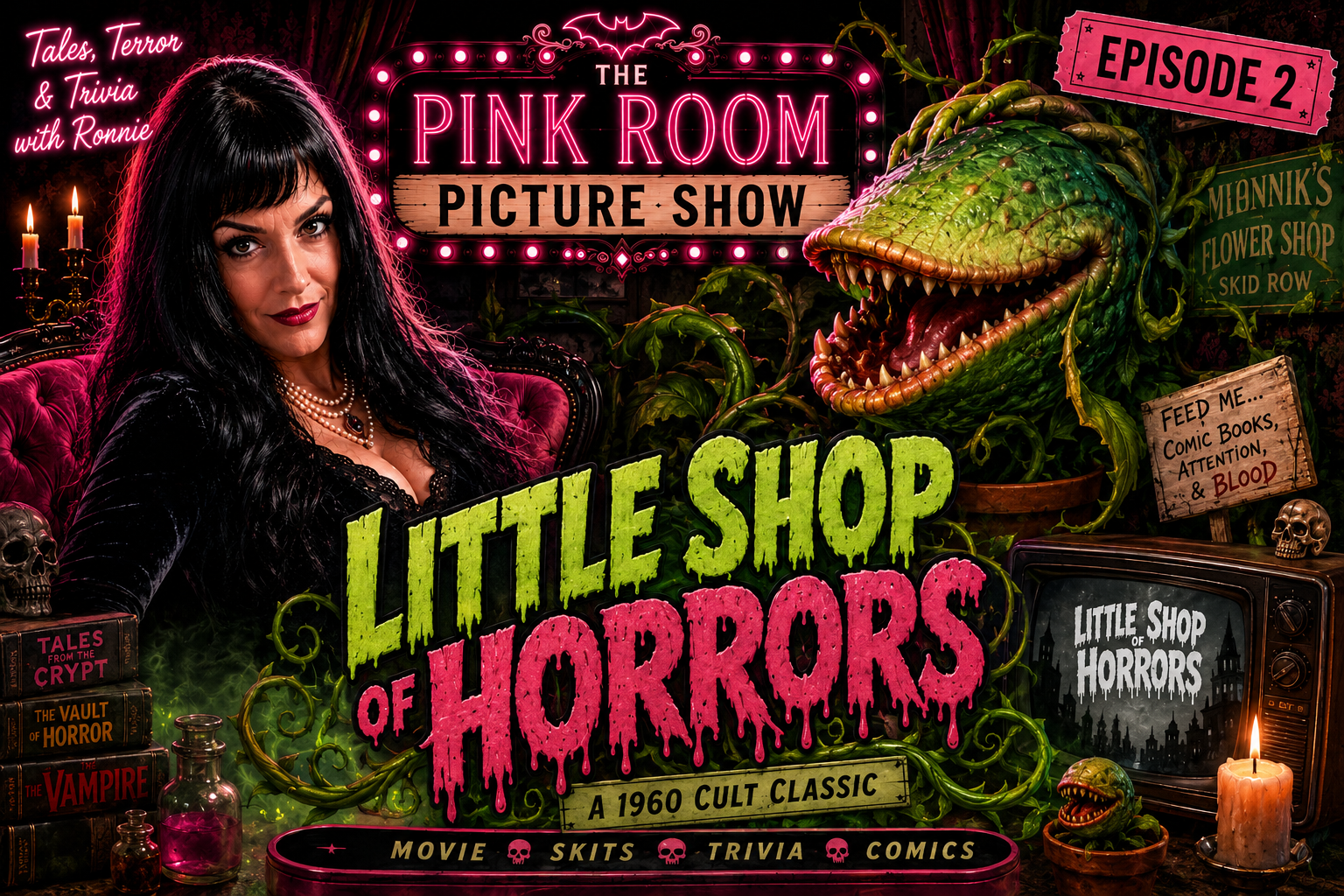
The Pink Room Picture Show · Episode 2
Flowers, murder and one very hungry plant.
Roger Corman’s gloriously odd horror comedy turns a shabby flower shop into the most dangerous attraction on Skid Row.
Hello, my darlings—and welcome to Mushnick’s Flower Shop, where business is wilting, romance is awkward and the newest plant on display has an appetite no amount of fertilizer can satisfy.
The Little Shop of Horrors is Roger Corman at his fastest, strangest and most playful: a black comedy assembled with B-movie ingenuity, populated by lovable eccentrics and powered by the increasingly desperate question of what poor Seymour will feed Audrey Junior next.
Watch the complete movie with Veronica in the Pink Room
- Title
- The Little Shop of Horrors
- Release
- 1960
- Director & producer
- Roger Corman
- Writer
- Charles B. Griffith
- Starring
- Jonathan Haze, Jackie Joseph, Mel Welles and Dick Miller
- Runtime
- 70 minutes
A Flower Shop on the Edge of Disaster
Seymour Krelboined works for Gravis Mushnick, the perpetually exasperated owner of a failing Skid Row flower shop. Seymour is clumsy, nervous and hopelessly in love with his co-worker Audrey Fulquard. His one chance to prove himself arrives in the form of a peculiar plant he has raised from an unidentified seed.
The strange little specimen draws customers and saves Seymour’s job, but it soon reveals the flaw in this promising arrangement: ordinary plant food will not do. Audrey Junior wants blood. As the plant grows, so does its voice, its appetite and Seymour’s panic.
Feed me. Feed me. I’m hungry!
Roger Corman’s Two-Day Miracle
The production has become legendary for its speed. Corman reused sets left standing from A Bucket of Blood, rehearsed quickly and photographed the story with the efficiency that made him the king of independent filmmaking. The result does not feel cautious or overworked. It moves with the cheerful recklessness of everyone involved knowing they have very little time and deciding to make that part of the fun.
Charles B. Griffith’s screenplay treats reality as optional. Characters misunderstand one another, jokes arrive from unexpected directions and the film leaps from romance to murder to police parody without asking permission. Its handmade energy is not something a polished remake could reproduce. This movie is alive in precisely the same unruly way as Audrey Junior.
Seymour, Audrey and Mushnick
Jonathan Haze makes Seymour both ridiculous and oddly sympathetic. He is not a criminal mastermind; he is a frightened young man whose attempts to solve one problem create three more. Jackie Joseph gives Audrey a sweet sincerity that keeps the romance from disappearing beneath the farce, while Mel Welles turns Mushnick’s outrage into a wonderfully elastic comic performance.
The flower shop becomes a stage for an entire neighborhood of eccentrics. Dick Miller appears as Burson Fouch, a customer who eats flowers as casually as other people eat candy. Myrtle Vail nearly steals the picture as Seymour’s spectacularly hypochondriacal mother, who treats every ailment like a cherished hobby.
A Young Jack Nicholson Goes to the Dentist
The film’s most famous detour belongs to Jack Nicholson as Wilbur Force, a gleefully masochistic dental patient. He appears only briefly, but the performance is unmistakable: the grin, the manic timing and the feeling that this young actor has discovered a private joke no one else in the room fully understands.
The dental sequence has little interest in advancing the plant story. It exists because it is funny, strange and perfectly suited to the movie’s crooked universe. That freedom is one of the film’s greatest pleasures.
From Tiny Production to Cult Institution
The movie’s afterlife grew far beyond its modest beginnings. It became a favorite at midnight screenings and art houses, inspiring audiences to shout lines and participate long before interactive cult cinema became familiar. Its central idea later bloomed into the off-Broadway musical by Howard Ashman and Alan Menken and the beloved 1986 film adaptation.
Yet the 1960 original remains its own creature. It is scrappier, darker and more absurd. Audrey Junior is less a polished star than a botanical nightmare assembled in the back room, which makes the danger feel both hilarious and strangely intimate.
Why It Belongs in the Pink Room
The Little Shop of Horrors understands something essential about horror comedy: the monster can be frightening, but the people surrounding it should be even stranger. It mixes old-Hollywood faces, beatnik energy, slapstick murder and a talking plant into a movie that never pauses long enough to become respectable.
That is exactly why it belongs here. The Pink Room Picture Show celebrates movies with personality—films whose ambitions outgrew their budgets and whose oddest choices became the reason audiences still love them.
Sources & Further Reading
- AFI Catalog: The Little Shop of Horrors — cast, crew, runtime, release history and cult reception.
- Wikimedia Commons: The Little Shop of Horrors — public-domain film files and historical information.
Mind the vines, my darling. Audrey Junior has noticed you.
VeronicaTot Comics · Because Comics Deserve Couture Too
Leave a Reply