The Pink Room Picture Show · Episode 4
The dead rise—and modern horror is born.
George A. Romero turns one lonely Pennsylvania farmhouse into a nightmare that changed horror cinema forever.
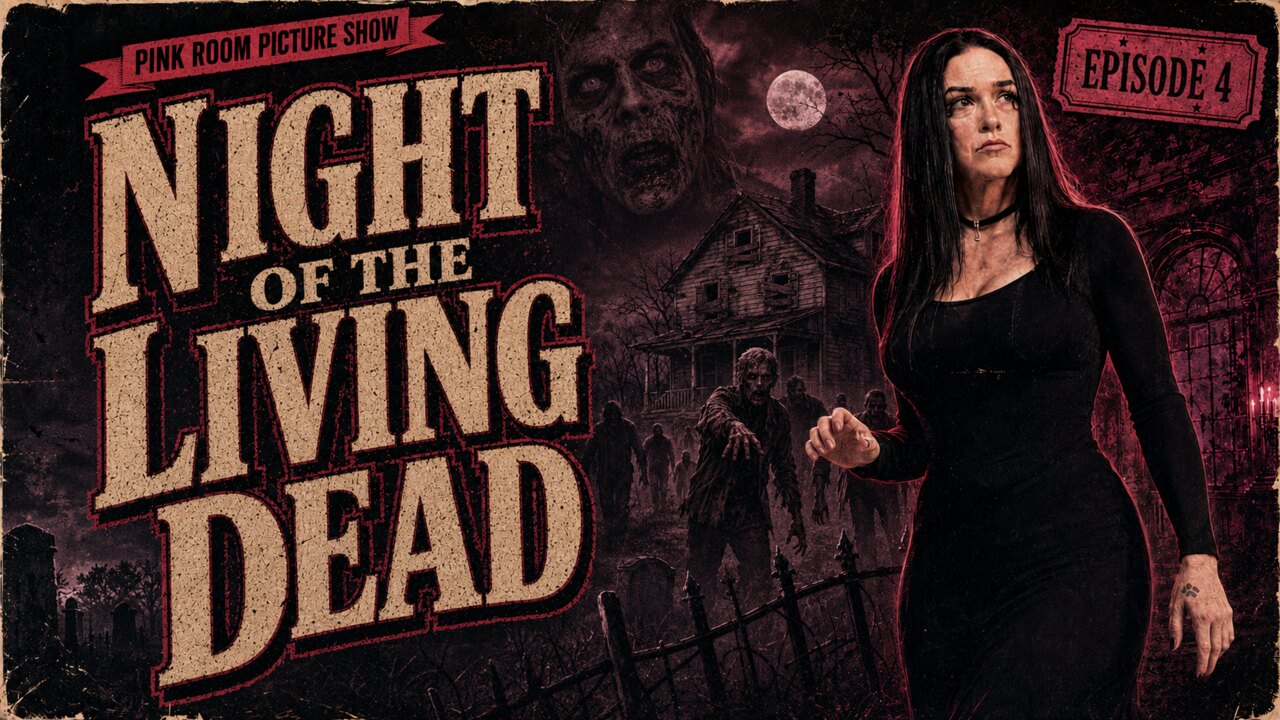
Hello, my darlings—and welcome to the night when the cemetery stopped being quiet, the farmhouse became a fortress and the dead discovered they could walk.
Night of the Living Dead did not merely introduce a new kind of monster. George A. Romero’s stark 1968 nightmare changed where horror could happen, who could stand at its center and how mercilessly a movie could confront its audience.
Watch the complete movie with Veronica in the Pink Room
- Title
- Night of the Living Dead
- Release
- 1968
- Director
- George A. Romero
- Writers
- George A. Romero and John A. Russo
- Starring
- Duane Jones, Judith O’Dea, Karl Hardman, Marilyn Eastman, Judith Ridley and Keith Wayne
- Production
- Image Ten
They’re Coming to Get You, Barbra
The opening is almost playful. Barbra and her brother Johnny visit their father’s grave, trading complaints and childhood teasing beneath a pale sky. Then a strange man appears among the stones. Within minutes Johnny is dead, Barbra is fleeing through the countryside and the familiar world has ended without warning.
She reaches an isolated farmhouse where Ben, played by Duane Jones, takes control. He boards the windows, searches for supplies and tries to understand the scattered radio reports. Other survivors emerge from the cellar, but safety becomes impossible when fear, pride and incompatible plans turn the people inside against one another.
The monsters outside are terrifying. The certainty that the people inside cannot cooperate is worse.
Duane Jones Changes the Center of the Story
Ben is intelligent, decisive and physically capable—the person most prepared to survive. Duane Jones gives him authority without turning him into a simple action hero. He thinks, listens, argues and sometimes loses his temper because the situation demands more from him than anyone should have to give.
Romero and his collaborators said Jones was cast because he was the best actor available, and the screenplay was not rewritten around his race. Yet placing a Black man at the center of an American horror film in 1968 inevitably transformed the movie’s meaning. Ben’s struggle for control inside the farmhouse and the devastating final images carry a force the filmmakers could not separate from the world outside the theater.
A New Kind of Living Dead
Earlier screen zombies were often linked to hypnosis, magic or distant exoticism. Romero’s creatures are ordinary dead people returned with an appetite for living flesh. They move slowly, gather in numbers and turn every familiar neighbor into a possible threat.
The movie calls them ghouls, but audiences recognized the foundation of the modern zombie. Countless later films, television series, comics and games inherited Romero’s rules: destroy the brain, fear the bite and understand that one creature is manageable while a crowd becomes the end of civilization.
Horror in an Ordinary Place
The farmhouse is not a Gothic castle or a laboratory. It is a plain rural home filled with furniture, tools, a television and a cellar. That familiarity makes the siege feel immediate. The nightmare is not happening in a distant land; it is unfolding down the road.
The grainy black-and-white photography gives the images the urgency of news footage. Radio and television broadcasts provide fragments of explanation, but no comforting authority arrives to restore order. The world beyond the boards feels as frightened and confused as the people trapped inside.
The Ending That Refuses Comfort
Without spoiling every turn for viewers entering the farmhouse for the first time, the conclusion remains one of the most brutal in American horror. Romero does not reward competence, courage or audience loyalty. Morning does not guarantee salvation.
The final sequence of still photographs resembles documentary evidence rather than a conventional movie ending. The horror continues after the last scream because the images force us to consider not only what happened, but how casually the world processes it.
From Regional Production to American Landmark
Made independently around Pittsburgh, Night of the Living Dead became a phenomenon far beyond its modest resources. Its violence shocked early audiences, its bleakness divided critics and its influence spread through nearly every corner of modern horror.
In 1999, the Library of Congress selected the film for the National Film Registry as a work of cultural, historical or aesthetic significance. The honor recognized what horror fans already knew: this was not merely a successful monster movie. It was a turning point in American cinema.
Why It Belongs in the Pink Room
The Pink Room Picture Show celebrates films whose imagination exceeded their budgets and whose creators built worlds that audiences could never forget. Few movies embody that spirit more completely than Night of the Living Dead.
It is raw, intelligent, frightening and unwilling to flatter us. More than half a century later, the farmhouse door still feels fragile, the radio reports still feel urgent and the figures moving across the field still make us check the windows.
Sources & Further Reading
- AFI Catalog: Night of the Living Dead — cast, crew, release and production information.
- Library of Congress National Film Registry — the film’s 1999 selection.
- Wikimedia Commons: Night of the Living Dead — public-domain film materials and rights information.
Keep the doors barred, my darling. Something is moving beyond the porch light.
VeronicaTot Comics · Because Comics Deserve Couture Too
Leave a Reply