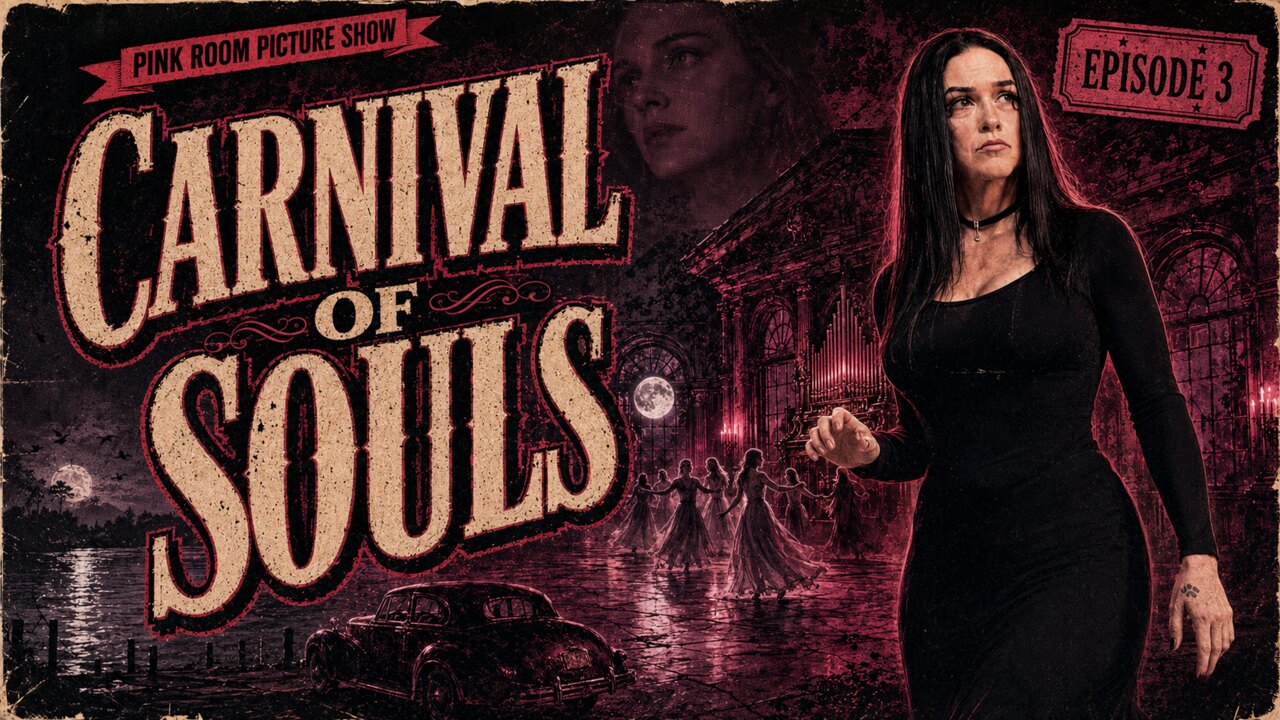
The Pink Room Picture Show · Episode 3
She survived the river—but something followed her out.
Herk Harvey’s eerie masterpiece drifts between loneliness, nightmare and a ruined pavilion waiting beside the salt flats.
Hello, my darlings—and welcome to the abandoned pavilion, where the organ plays after midnight, pale figures dance beneath broken lights and one woman cannot decide whether she escaped death or merely wandered deeper inside it.
Carnival of Souls is not interested in loud shocks. It works through silence, distance and disconnection, following Mary Henry through a world that gradually stops acknowledging her existence.
Watch the complete movie with Veronica in the Pink Room
- Title
- Carnival of Souls
- Release
- 1962
- Director & producer
- Herk Harvey
- Writer
- John Clifford
- Starring
- Candace Hilligoss, Frances Feist, Sidney Berger and Herk Harvey
- Music
- Gene Moore
The Woman Who Walked Out of the River
A car carrying three young women plunges from a bridge into a muddy river. Hours later, Mary Henry emerges from the water as the only apparent survivor. She leaves Kansas for a new job as a church organist in Utah, determined to build a life untouched by the tragedy.
But Mary never fully rejoins the living world. Conversations feel distant. People seem unable to hear her. A pale man appears in windows and reflections, watching with an expression that is less violent than inevitable. At the edge of the city stands an abandoned lakeside pavilion, and Mary feels drawn toward it despite every instinct telling her to stay away.
The terror is not that Mary is being chased. It is that the world may already have let her go.
Candace Hilligoss and the Loneliness of Mary Henry
Candace Hilligoss gives Mary a cool, guarded presence. She is independent without seeming secure, observant without understanding what she sees and increasingly frightened by the possibility that her isolation is not merely emotional.
Mary’s refusal to perform warmth for the people around her makes her unusual for a heroine of the period. She does not want romance, community or the approval of her intrusive neighbor John Linden. She wants work, privacy and control. The film slowly removes each of those certainties.
The Pavilion at the Edge of Reality
The abandoned Saltair pavilion is one of horror cinema’s great locations. Its long corridors, empty dance floor and decaying architecture feel designed for a celebration that ended decades ago but never truly stopped.
Herk Harvey first saw the ruined resort while passing through Utah and imagined pale figures rising from the water to dance inside it. That image became the film’s center. The pavilion is not simply haunted; it seems to occupy a space where memory, death and desire overlap.
An Organ Score from Another World
Gene Moore’s organ music gives the film its pulse. Because Mary is an organist, the sound belongs naturally to her everyday life, yet it also seems to come from somewhere beneath the story. Sacred chords twist into carnival rhythms, and the familiar instrument becomes a doorway.
The score allows the movie to drift between the real and unreal without announcing the transition. By the time the ghouls begin their dance, the music has already taught us that Mary’s world can change shape at any moment.
Herk Harvey’s One Impossible Feature
Harvey spent most of his career directing industrial and educational films for the Centron Corporation in Lawrence, Kansas. Carnival of Souls was his only feature, made with a small regional crew and photographed on location in Kansas and Utah.
Its limited resources became its aesthetic. Empty streets, harsh daylight, doubled voices and ordinary rooms acquire an uncanny stillness. What might look imperfect in another production feels here like evidence that Mary has slipped slightly out of alignment with reality.
The Film That Would Not Stay Buried
The initial release did little to establish the movie, but late-night television and revival screenings gradually found its audience. Filmmakers and critics recognized its dream logic, stark photography and sense of cosmic isolation.
Its influence can be felt in later psychological horror and in filmmakers fascinated by unstable identity and haunted spaces. Criterion’s restoration and the Academy Film Archive’s preservation work helped secure the film’s place as far more than an accidental midnight curiosity.
Why It Belongs in the Pink Room
Carnival of Souls belongs in the Pink Room because it turns atmosphere into an entire universe. It proves that horror can be elegant, lonely and beautiful—that a deserted ballroom and a few distant figures can disturb us more deeply than spectacle.
Mary Henry walks through doors without knowing whether they lead toward life or away from it. That uncertainty is the film’s spell, and more than sixty years later, the music still calls audiences back to the pavilion.
Sources & Further Reading
- The Criterion Collection: Carnival of Souls — the film’s themes, production and enduring influence.
- Criterion Channel — film overview and cult legacy.
- Wikimedia Commons film record — hosted edition and U.S. public-domain statement.
The music has started, my darling. Try not to join the dance.
VeronicaTot Comics · Because Comics Deserve Couture Too
Leave a Reply