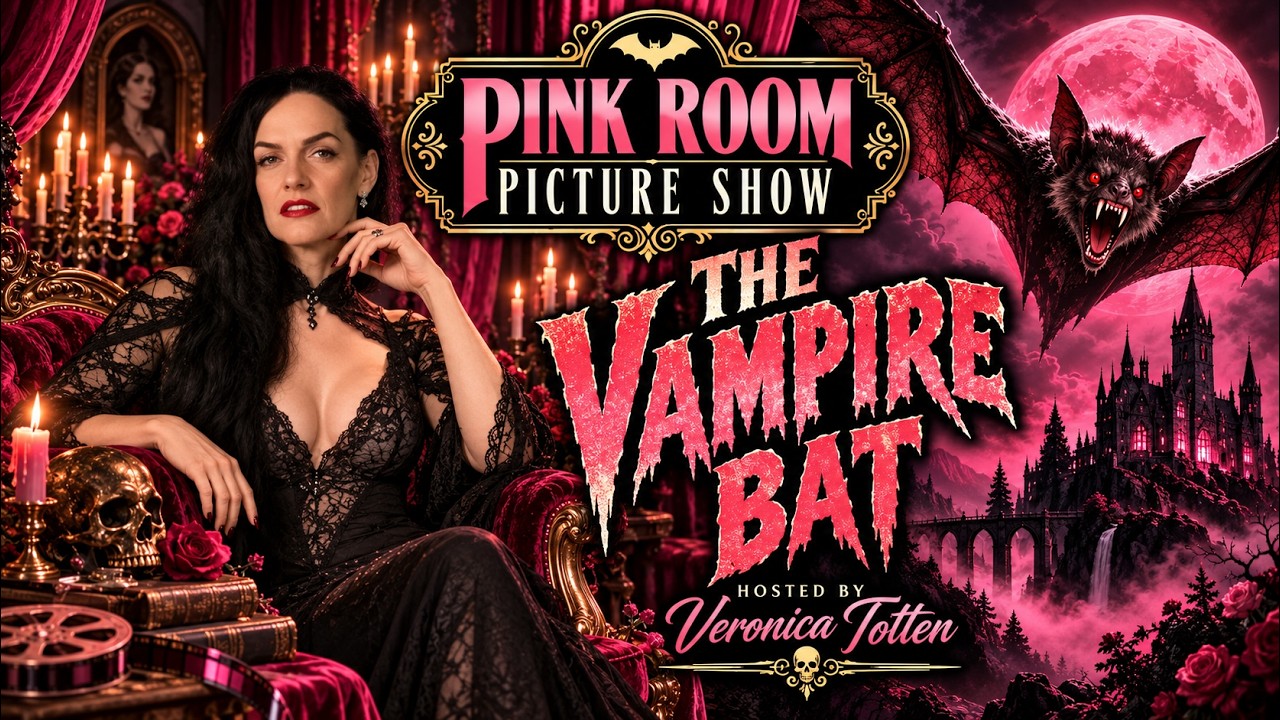
The Pink Room Picture Show
The village believes in vampires. The truth is much stranger.
Bloodless bodies, frightened villagers, a suspicious doctor and one wonderfully unsettling Dwight Frye performance—welcome to Kleinschloss.
Hello, my darlings—and welcome to Kleinschloss, where the bodies are turning up drained of blood, the villagers are whispering about vampires and the local doctor may know rather more than he is letting on.
Released in 1933, The Vampire Bat is one of those gloriously efficient little pre-Code horror pictures that seems determined to squeeze every possible gothic pleasure into a compact running time: bats, blood, torch-bearing villagers, a laboratory, a beautiful heroine, a skeptical investigator and enough suspicion to make practically everyone look guilty.
It also arrives with a cast that horror fans know very well. Lionel Atwill leads the madness as Dr. Otto von Niemann, Fay Wray plays Ruth Bertin, Melvyn Douglas is police inspector Karl Brettschneider, and Dwight Frye turns up as Herman Gleib—a lonely eccentric whose fondness for bats makes him an extremely inconvenient man to be when a frightened village decides a vampire is on the loose.
Watch the complete movie with Veronica in the Pink Room
- Title
- The Vampire Bat
- Release
- January 21, 1933
- Directed by
- Frank Strayer
- Screen story
- Edward T. Lowe
- Starring
- Lionel Atwill, Fay Wray, Melvyn Douglas and Dwight Frye
- Production
- Majestic Pictures Corp.
- Photography
- Ira Morgan
- Runtime
- AFI lists 62–63 or 67 minutes; longer circulating versions also exist
Something Is Draining Kleinschloss Dry
The film wastes very little time getting to the problem. A series of murders has left the Central European village of Kleinschloss terrified. The victims are found drained of blood, with puncture wounds near the throat, and the townspeople reach the obvious conclusion long before the authorities do: there is a vampire among them.
Inspector Karl Brettschneider is not convinced. He wants evidence, not folklore. Dr. von Niemann, however, is perfectly willing to discuss the historical possibility of blood-drinking creatures—and in a town already primed for panic, that is all the encouragement superstition needs.
The smartest trick in The Vampire Bat is that it lets superstition and science accuse one another while something far uglier hides between them.
Dwight Frye and the Cruelty of Suspicion
Herman Gleib may be the saddest figure in the picture. Dwight Frye had already given horror cinema two unforgettable damaged souls in Dracula and Frankenstein, and here he once again plays a man whose strangeness makes him an easy target.
Herman likes bats. He is socially awkward. He wanders where respectable people think he should not wander. In a calm town, those things might make him merely peculiar. In a terrified one, they become evidence.
That makes the villagers’ fear more disturbing than the supernatural rumor itself. Once the community decides what Herman is, proof becomes unnecessary. The mob simply needs somewhere to put its terror.
Lionel Atwill, Fay Wray and a Cast Built for Horror
Lionel Atwill brings exactly the polished menace the role demands. His Dr. von Niemann is cultured, authoritative and composed—the sort of man a frightened village wants to trust because he sounds as though he has already understood the problem.
Fay Wray, appearing in the same extraordinary year that would make her immortal through King Kong, gives the picture its romantic and human center as Ruth. Melvyn Douglas provides the skeptical counterweight as Karl, while the supporting cast supplies that marvelous early-1930s mix of village comedy, melodrama and graveyard seriousness.
TCM notes that the film belongs to the wave of horror pictures produced after the success of Universal’s Dracula and Frankenstein. Majestic Pictures did not have Universal money, but The Vampire Bat knew exactly which shadows audiences had fallen in love with.
When the Vampire Story Becomes Mad Science
The title promises a vampire picture, but the film is slyer than that. It uses vampire folklore to create fear, then slowly shifts toward another obsession of early horror: the scientist who believes discovery places him above ordinary morality.
That collision is what makes the movie such fun. One half belongs to torchlight, crucifixes and terrified villagers. The other belongs to hidden laboratories, experimental tissue and a doctor convinced that human lives are acceptable material for his work.
The movie does not choose between gothic horror and mad science. It throws them into the same room and lets each make the other worse.
Pre-Code Horror Before the Rules Tightened
The Vampire Bat arrived before Hollywood’s Production Code began being enforced with full force in 1934. The result is not shocking by modern standards, but the picture has that wonderfully unruly early-1930s flavor: death, blood, hysteria, medical obsession and moral ugliness are allowed to sit close to the surface.
It also moves with the speed of a pulp story. There is almost no wasted space. Suspicions change, bodies appear, the mob gathers and the laboratory waits behind the respectable façade.
And No, There Was Not a Comic Adaptation
This is where I have to disappoint the comic collector in all of us.
There is no vintage The Vampire Bat comic adaptation sitting in the Pink Room collection waiting for its grand reveal. We are not going to invent one simply because that title would look absolutely fabulous on a lurid ten-cent horror cover.
Would it have fit beautifully beside the pre-Code horror books that arrived two decades later? Absolutely. Bloodless corpses, bats, mad science, villagers with torches and a sinister doctor are practically begging for four-color treatment.
But part of the fun of the Pink Room Picture Show is knowing where the real connections end and where our collector imaginations begin. The Vampire Bat has the atmosphere of a horror comic without needing us to manufacture a history it never had.
A Small Horror Film with a Long Afterlife
For decades the movie circulated in rough, battered prints that did it few favors. TCM notes that UCLA Film & Television Archive created preservation prints and a digital master in 2017 from the best surviving material, restoring detail that had been lost in generations of poor copies.
That matters because The Vampire Bat is an atmospheric movie. Its village streets, cave, shadows and torchlight are part of the experience. When those images survive properly, the film looks far more deliberate—and far less disposable—than its old bargain-bin reputation suggested.
Why It Belongs in the Pink Room
The Vampire Bat belongs here because it sits at one of my favorite crossroads in horror: gothic superstition on one side, dangerous science on the other, and human fear making a mess of everything in between.
It has stars. It has atmosphere. It has Dwight Frye being wonderfully unsettling. It has Fay Wray. It has a laboratory nobody should enter after dark.
And it has a title that still sounds like it should be printed in blood-red letters across the top of a comic book.
Sources & Further Reading
- AFI Catalog: The Vampire Bat — release information, cast, production credits, running time and synopsis.
- Turner Classic Movies: The Vampire Bat — production history, cast context and notes on the UCLA preservation.
Lock the doors, my darling. The villagers have torches, the bats are restless, and I do not trust that doctor one bit.
VeronicaTot Comics · Because Comics Deserve Couture Too
Leave a Reply